
visualize in 3D,” José said. “Fortunately, I had a history professor who thought I wrote well and took an interest in me. He’s the one who suggested I consider law, even though I had never met a lawyer.” FATHER KNOWS BEST After UNLV, José made his way to Stanford University with Virginia, now his new bride. There, their family began to grow with the birth of their eldest son, Javier. “I am in the Stanford Law School yearbook, though I was just a baby,” Dr. Javier Cárdenas said with a laugh. After José completed law school, he got an offer from a big firm in Los Angeles. But the more the young family considered their options, the less appealing a big city was. José was interested in criminal law and moved the family to Phoenix in 1978 to work for the firm of Lewis and Roca (now Lewis Roca Rothgerber Christie), where he stayed until 2009. During those years, José and Virginia put down deep roots in the Valley. They welcomed two more sons, José Luis and Sergio, and became tireless community champions. “I can’t say that Virginia and I had this grand scheme, but we did try to model commitment to family, to community, to being honest and working hard,” José said. “I can’t say that I was a ‘Father Knows Best’ type of father with profound messages for my children. But I think Virginia and I both tried to model what we thought was good behavior.” A DIFFERENT ROAD Their approach seems to have worked. Javier graduated from Chandler High School and went on to earn an education degree at ASU. He taught for a year at Tolleson Union High School, but an early career experience ultimately steered him down a different road. As part of a student-teaching session, he went back to Chandler High to train in special education. He spoke with the parents of students he was helping, asking what it was like to raise a child with a disability. “Something that stuck with me is that their experience with physicians was poor. Either the physician would not speak to the child at all, or the physician would speak to the child in baby talk, or they would blame the mother for the child’s neurological condition,” Javier said. These conversations inspired him to move on from teaching and enroll in medical school at the University of Arizona. From there he found his way to pediatric neurology, where another chance encounter would solidify his path. A 7-year-old named Emily had been riding an ATV and suffered a brain injury from an accident. “It really had an impact on me,” Javier said. “So I thought that I would work to create a program to address brain injuries for those individuals who are discharged from the hospital or go to the ER and don’t have a place to have comprehensive care.” As a result, Javier created the Barrow Concussion & Brain Injury Center, which is the nation’s most comprehensive concussion prevention, treatment and education program. The center works to address brain injuries in all forms, whether they’re from car crashes, sports or domestic violence. “We try to address these injuries in the most comprehensive manner we can. We have a team of neurologists, neuropsychologists and psychiatrists to help address the physical, behavioral and cognitive deficits associated with brain injury,” Javier said. As director, Javier also created the Barrow Brainbook, which Arizona high school students must complete to participate in school sports. It’s the first mandated online concussion education and testing tool for student athletes in the country. More than 400,000 Arizona youths have completed the training since it launched in 2011. Javier is proud of Arizona’s leading role in concussion education, legislation and policy. “We were one of the first states to restrict contact practices in football, and we remain the first to restrict the number of heading practices in soccer,” he said. “We came out with something called the helmet dislodgement rule, which COVER STORY CONTINUED 22 FRONTDOORS MEDIA | SEPTEMBER 2018
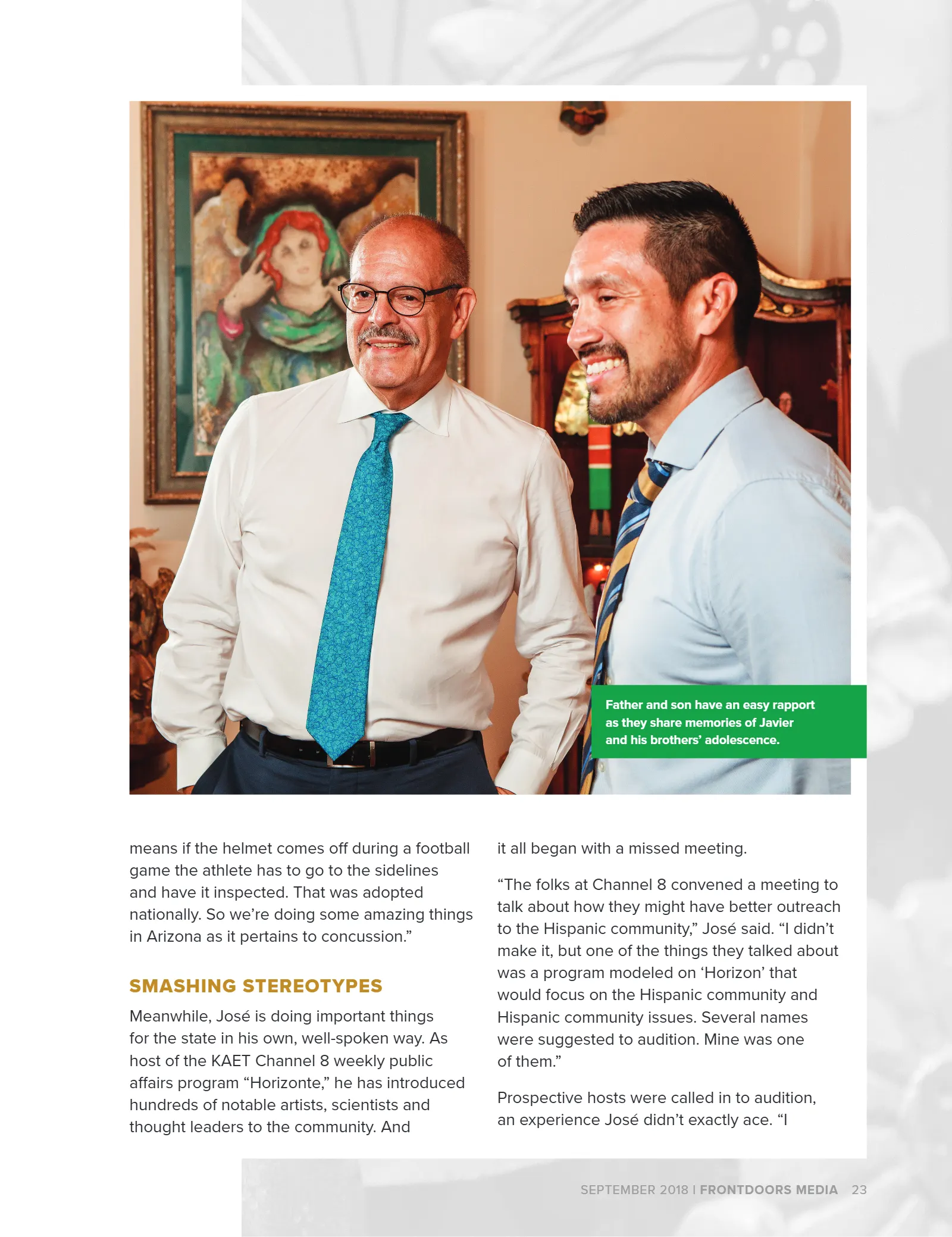
means if the helmet comes off during a football game the athlete has to go to the sidelines and have it inspected. That was adopted nationally. So we’re doing some amazing things in Arizona as it pertains to concussion.” SMASHING STEREOTYPES Meanwhile, José is doing important things for the state in his own, well-spoken way. As host of the KAET Channel 8 weekly public affairs program “Horizonte,” he has introduced hundreds of notable artists, scientists and thought leaders to the community. And it all began with a missed meeting. “The folks at Channel 8 convened a meeting to talk about how they might have better outreach to the Hispanic community,” José said. “I didn’t make it, but one of the things they talked about was a program modeled on ‘Horizon’ that would focus on the Hispanic community and Hispanic community issues. Several names were suggested to audition. Mine was one of them.” Prospective hosts were called in to audition, an experience José didn’t exactly ace. “I Father and son have an easy rapport as they share memories of Javier and his brothers’ adolescence. SEPTEMBER 2018 | FRONTDOORS MEDIA 23