
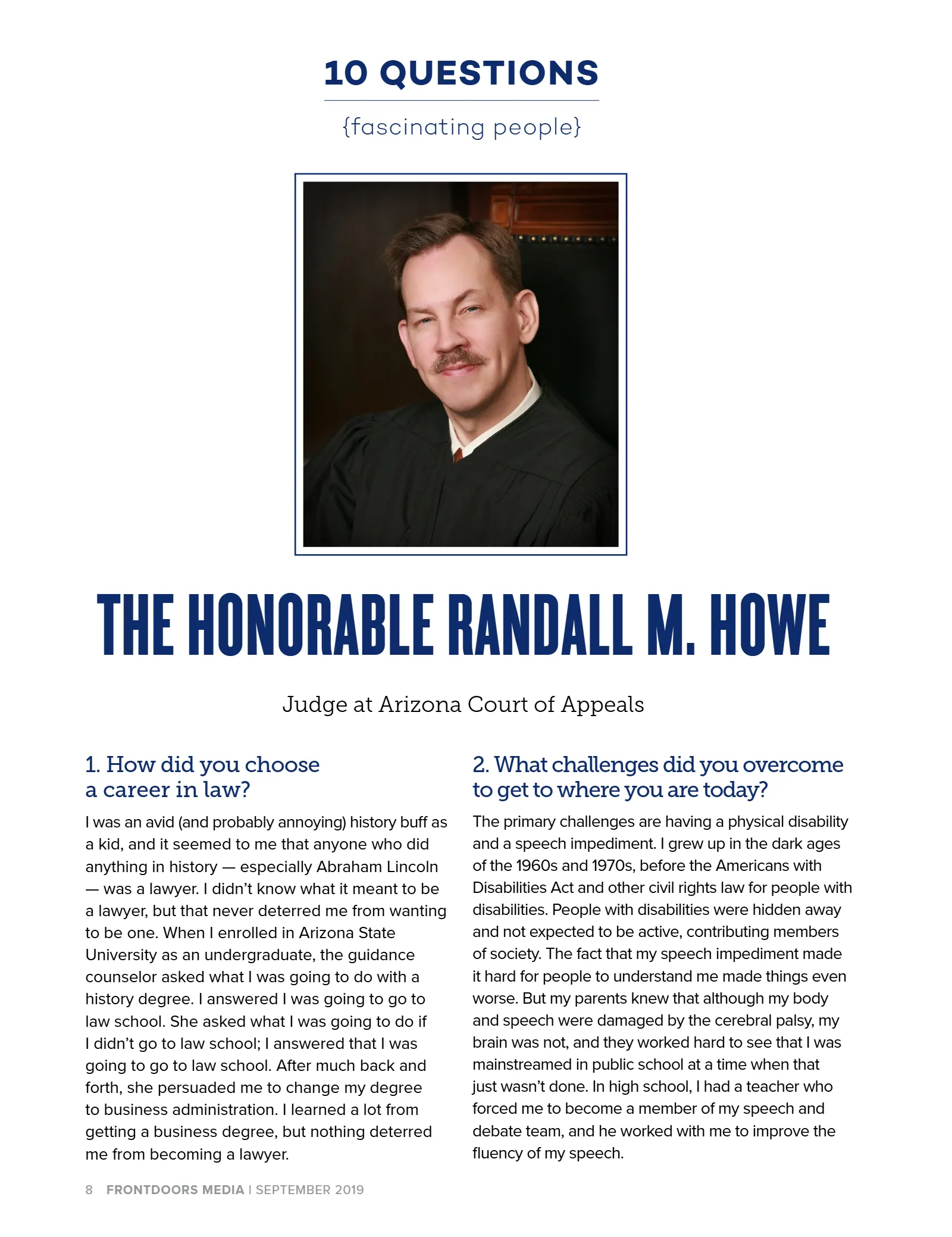
Judge at Arizona Court of Appeals 1. How did you choose a career in law? I was an avid (and probably annoying) history buff as a kid, and it seemed to me that anyone who did anything in history — especially Abraham Lincoln — was a lawyer. I didn’t know what it meant to be a lawyer, but that never deterred me from wanting to be one. When I enrolled in Arizona State University as an undergraduate, the guidance counselor asked what I was going to do with a history degree. I answered I was going to go to law school. She asked what I was going to do if I didn’t go to law school; I answered that I was going to go to law school. After much back and forth, she persuaded me to change my degree to business administration. I learned a lot from getting a business degree, but nothing deterred me from becoming a lawyer. THE HONORABLE RANDALL M. HOWE 2. What challenges did you overcome to get to where you are today? The primary challenges are having a physical disability and a speech impediment. I grew up in the dark ages of the 1960s and 1970s, before the Americans with Disabilities Act and other civil rights law for people with disabilities. People with disabilities were hidden away and not expected to be active, contributing members of society. The fact that my speech impediment made it hard for people to understand me made things even worse. But my parents knew that although my body and speech were damaged by the cerebral palsy, my brain was not, and they worked hard to see that I was mainstreamed in public school at a time when that just wasn’t done. In high school, I had a teacher who forced me to become a member of my speech and debate team, and he worked with me to improve the fluency of my speech. 10 QUESTIONS {fascinating people} 8 FRONTDOORS MEDIA | SEPTEMBER 2019
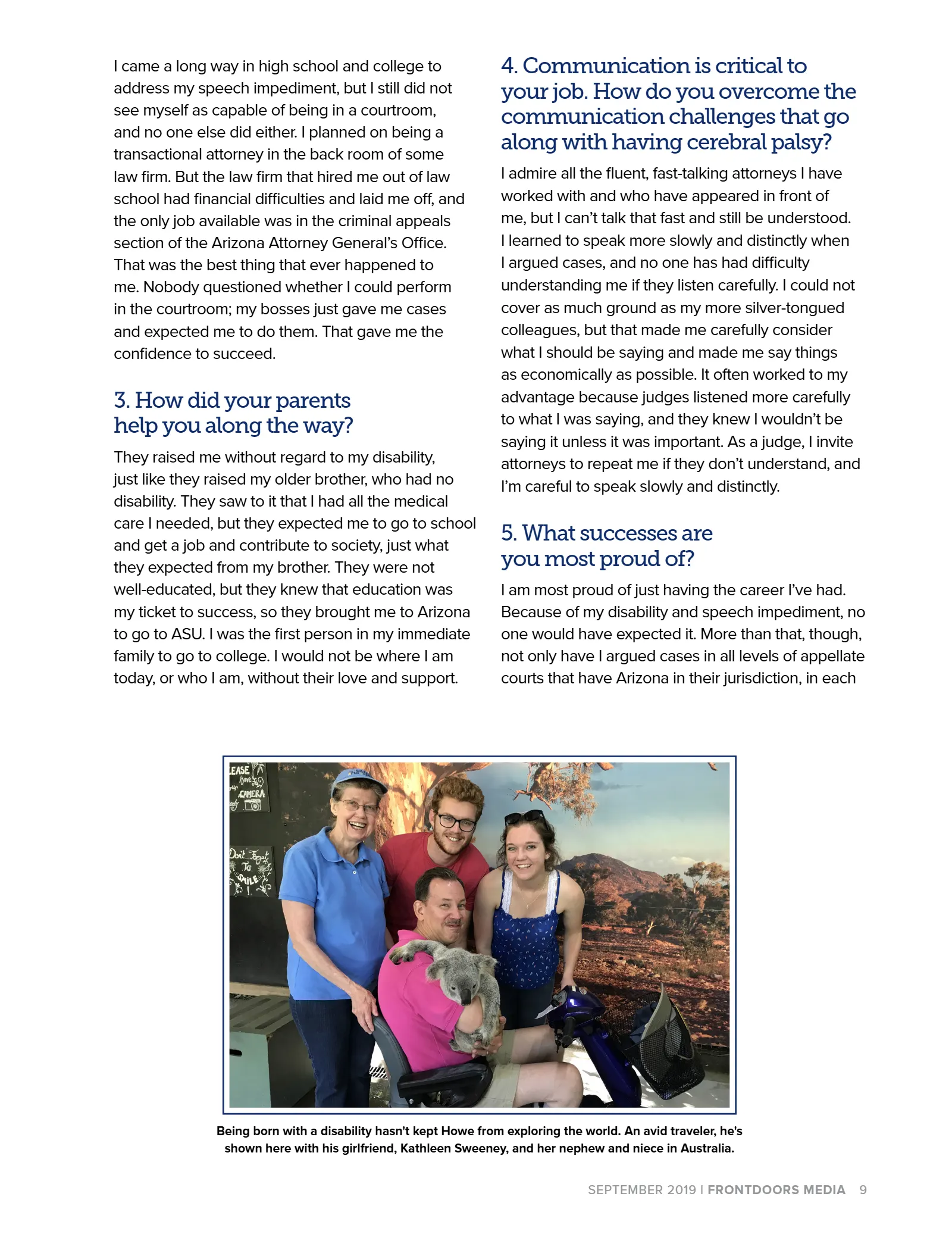
I came a long way in high school and college to address my speech impediment, but I still did not see myself as capable of being in a courtroom, and no one else did either. I planned on being a transactional attorney in the back room of some law firm. But the law firm that hired me out of law school had financial difficulties and laid me off, and the only job available was in the criminal appeals section of the Arizona Attorney General’s Office. That was the best thing that ever happened to me. Nobody questioned whether I could perform in the courtroom; my bosses just gave me cases and expected me to do them. That gave me the confidence to succeed. 3. How did your parents help you along the way? They raised me without regard to my disability, just like they raised my older brother, who had no disability. They saw to it that I had all the medical care I needed, but they expected me to go to school and get a job and contribute to society, just what they expected from my brother. They were not well-educated, but they knew that education was my ticket to success, so they brought me to Arizona to go to ASU. I was the first person in my immediate family to go to college. I would not be where I am today, or who I am, without their love and support. 4. Communication is critical to your job. How do you overcome the communication challenges that go along with having cerebral palsy? I admire all the fluent, fast-talking attorneys I have worked with and who have appeared in front of me, but I can’t talk that fast and still be understood. I learned to speak more slowly and distinctly when I argued cases, and no one has had difficulty understanding me if they listen carefully. I could not cover as much ground as my more silver-tongued colleagues, but that made me carefully consider what I should be saying and made me say things as economically as possible. It often worked to my advantage because judges listened more carefully to what I was saying, and they knew I wouldn’t be saying it unless it was important. As a judge, I invite attorneys to repeat me if they don’t understand, and I’m careful to speak slowly and distinctly. 5. What successes are you most proud of? I am most proud of just having the career I’ve had. Because of my disability and speech impediment, no one would have expected it. More than that, though, not only have I argued cases in all levels of appellate courts that have Arizona in their jurisdiction, in each SEPTEMBER 2019 | FRONTDOORS MEDIA 9 Being born with a disability hasn't kept Howe from exploring the world. An avid traveler, he's shown here with his girlfriend, Kathleen Sweeney, and her nephew and niece in Australia.