
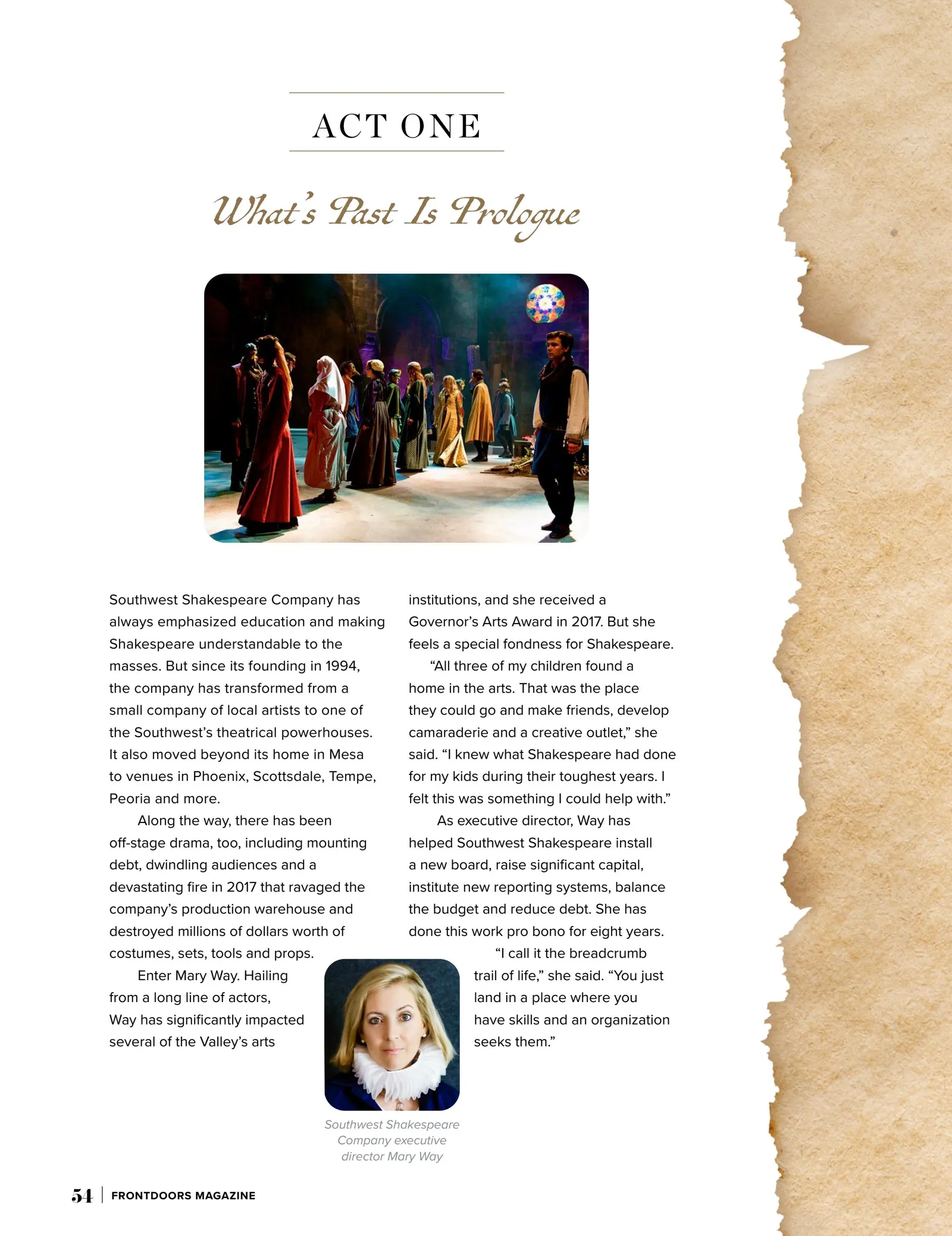
Southwest Shakespeare Company has always emphasized education and making Shakespeare understandable to the masses. But since its founding in 1994, the company has transformed from a small company of local artists to one of the Southwest’s theatrical powerhouses. It also moved beyond its home in Mesa to venues in Phoenix, Scottsdale, Tempe, Peoria and more. Along the way, there has been off-stage drama, too, including mounting debt, dwindling audiences and a devastating fire in 2017 that ravaged the company’s production warehouse and destroyed millions of dollars worth of costumes, sets, tools and props. Enter Mary Way. Hailing from a long line of actors, Way has significantly impacted several of the Valley’s arts institutions, and she received a Governor’s Arts Award in 2017. But she feels a special fondness for Shakespeare. “All three of my children found a home in the arts. That was the place they could go and make friends, develop camaraderie and a creative outlet,” she said. “I knew what Shakespeare had done for my kids during their toughest years. I felt this was something I could help with.” As executive director, Way has helped Southwest Shakespeare install a new board, raise significant capital, institute new reporting systems, balance the budget and reduce debt. She has done this work pro bono for eight years. “I call it the breadcrumb trail of life,” she said. “You just land in a place where you have skills and an organization seeks them.” ACT ONE What’s Past Is Prologue Southwest Shakespeare Company executive director Mary Way 54 | FRONTDOORS MAGAZINE
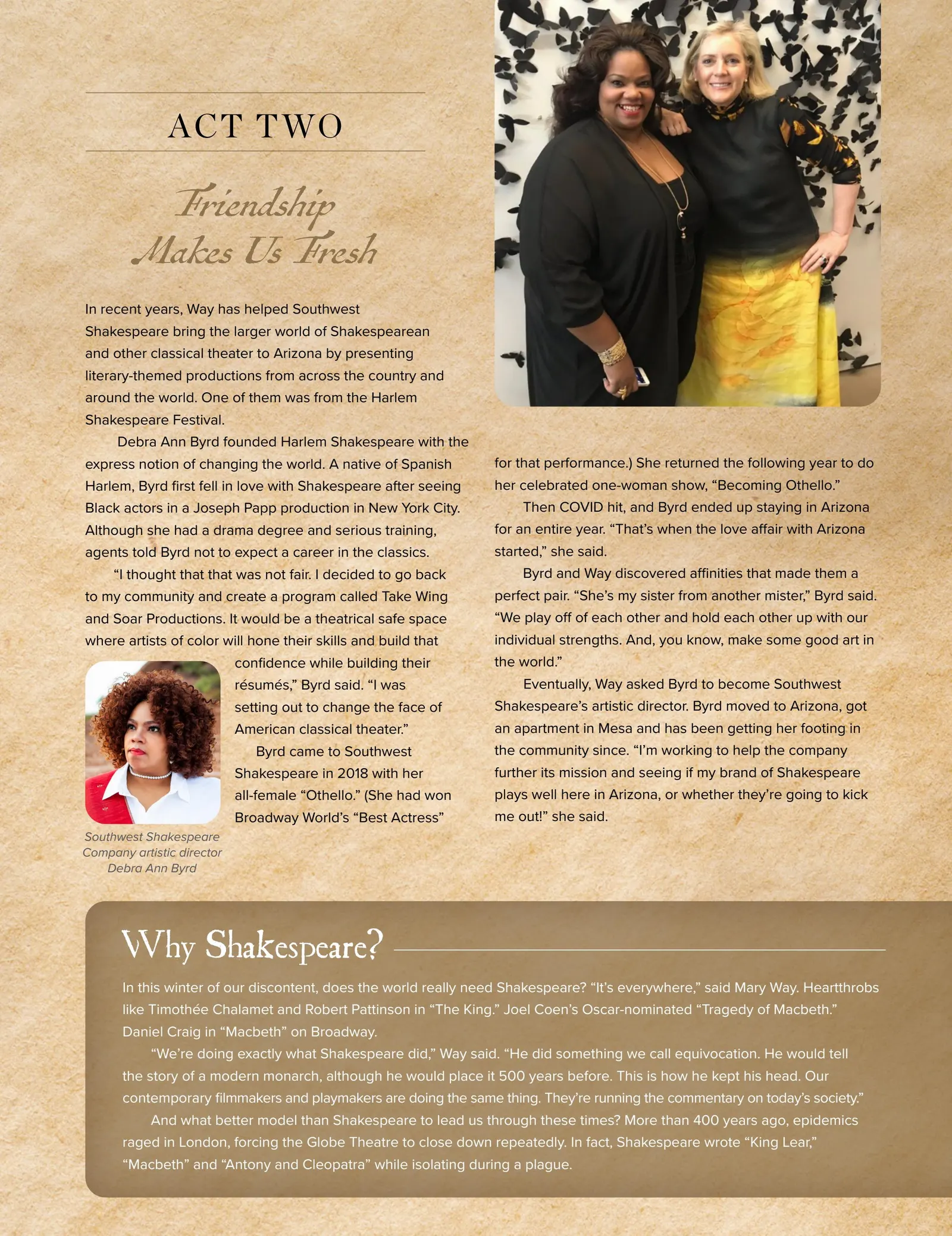
In recent years, Way has helped Southwest Shakespeare bring the larger world of Shakespearean and other classical theater to Arizona by presenting literary-themed productions from across the country and around the world. One of them was from the Harlem Shakespeare Festival. Debra Ann Byrd founded Harlem Shakespeare with the express notion of changing the world. A native of Spanish Harlem, Byrd first fell in love with Shakespeare after seeing Black actors in a Joseph Papp production in New York City. Although she had a drama degree and serious training, agents told Byrd not to expect a career in the classics. “I thought that that was not fair. I decided to go back to my community and create a program called Take Wing and Soar Productions. It would be a theatrical safe space where artists of color will hone their skills and build that confidence while building their résumés,” Byrd said. “I was setting out to change the face of American classical theater.” Byrd came to Southwest Shakespeare in 2018 with her all-female “Othello.” (She had won Broadway World’s “Best Actress” for that performance.) She returned the following year to do her celebrated one-woman show, “Becoming Othello.” Then COVID hit, and Byrd ended up staying in Arizona for an entire year. “That’s when the love affair with Arizona started,” she said. Byrd and Way discovered affinities that made them a perfect pair. “She’s my sister from another mister,” Byrd said. “We play off of each other and hold each other up with our individual strengths. And, you know, make some good art in the world.” Eventually, Way asked Byrd to become Southwest Shakespeare’s artistic director. Byrd moved to Arizona, got an apartment in Mesa and has been getting her footing in the community since. “I’m working to help the company further its mission and seeing if my brand of Shakespeare plays well here in Arizona, or whether they’re going to kick me out!” she said. ACT TWO Friendship Makes Us Fresh Southwest Shakespeare Company artistic director Debra Ann Byrd In this winter of our discontent, does the world really need Shakespeare? “It’s everywhere,” said Mary Way. Heartthrobs like Timothée Chalamet and Robert Pattinson in “The King.” Joel Coen’s Oscar-nominated “Tragedy of Macbeth.” Daniel Craig in “Macbeth” on Broadway. “We’re doing exactly what Shakespeare did,” Way said. “He did something we call equivocation. He would tell the story of a modern monarch, although he would place it 500 years before. This is how he kept his head. Our contemporary filmmakers and playmakers are doing the same thing. They’re running the commentary on today’s society.” And what better model than Shakespeare to lead us through these times? More than 400 years ago, epidemics raged in London, forcing the Globe Theatre to close down repeatedly. In fact, Shakespeare wrote “King Lear,” “Macbeth” and “Antony and Cleopatra” while isolating during a plague. Why Shakespeare ? ?