
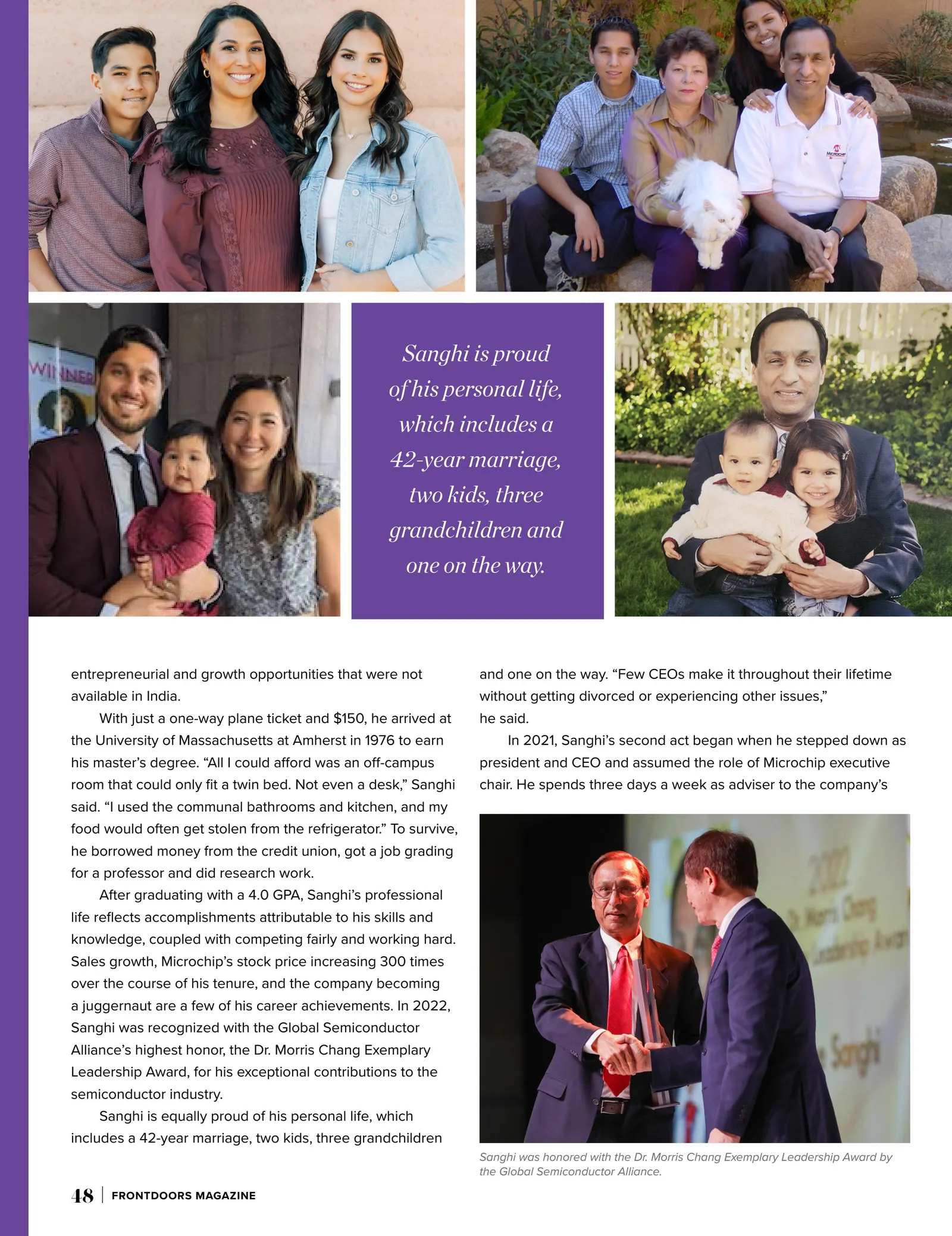
48 | FRONTDOORS MAGAZINE 48 | FRONTDOORS MAGAZINE entrepreneurial and growth opportunities that were not available in India. With just a one-way plane ticket and $150, he arrived at the University of Massachusetts at Amherst in 1976 to earn his master’s degree. “All I could afford was an off-campus room that could only fit a twin bed. Not even a desk,” Sanghi said. “I used the communal bathrooms and kitchen, and my food would often get stolen from the refrigerator.” To survive, he borrowed money from the credit union, got a job grading for a professor and did research work. After graduating with a 4.0 GPA, Sanghi’s professional life reflects accomplishments attributable to his skills and knowledge, coupled with competing fairly and working hard. Sales growth, Microchip’s stock price increasing 300 times over the course of his tenure, and the company becoming a juggernaut are a few of his career achievements. In 2022, Sanghi was recognized with the Global Semiconductor Alliance’s highest honor, the Dr. Morris Chang Exemplary Leadership Award, for his exceptional contributions to the semiconductor industry. Sanghi is equally proud of his personal life, which includes a 42-year marriage, two kids, three grandchildren Sanghi is proud of his personal life, which includes a 42-year marriage, two kids, three grandchildren and one on the way. and one on the way. “Few CEOs make it throughout their lifetime without getting divorced or experiencing other issues,” he said. In 2021, Sanghi’s second act began when he stepped down as president and CEO and assumed the role of Microchip executive chair. He spends three days a week as adviser to the company’s Sanghi was honored with the Dr. Morris Chang Exemplary Leadership Award by the Global Semiconductor Alliance.
CEO and management team. The remaining two are dedicated to helping entrepreneurs by serving as board chair for two private companies as well as giving back to the community. Investing in the community is a mainstay for Sanghi. More than three decades ago, he took the lead in working with Microchip’s management team and employees to identify eight areas of need in the community. There was a keen awareness that the company did not solely have the resources to address those needs and a partner was essential. Microchip collaborated with Valley of the Sun United Way over these many years. The holistic partnership includes financial support, as well as the time and expertise of Microchip employees. Three of these eight areas — education, entrepreneurship and workforce development — are the direct focus of Microchip’s community involvement. Sanghi will readily share how engineering is a crisis for the United States due to a lack of engineering graduates supporting the semiconductor industry, resulting in a need to hire from other countries. “The recognition of science and technology is very low among our youth. Unless you catch kids early enough and build their interest in science and technology, they’re going to be lost to pop culture,” he said. “If you ask most teenagers in high school about their role models, their response is singers, actors and sports heroes. Society gets what it celebrates.” Sanghi applied his signature drive and determination in shifting society’s celebration to science and technology when he brought the national nonprofit For Inspiration and Recognition of Science and Technology (FIRST) Robotics Competition to Arizona 20 years ago. Describing this as his “personal passion,” Sanghi has volunteered to mentor a majority-girls team that won the state competition, funds two annual scholarships, and underwrites the state championship held at ASU. Whether it’s teaching Microchip employees to take the time to figure out customer problems and how the company can solve them or nurturing a love of STEM through AZFirst, Sanghi continually leverages his entrepreneurial mindset to offer sustainable support to others. “Since I came here with nothing, I’ve always had the desire to provide opportunities for others who may not be able to reach their potential because they couldn’t get resources,” he said. “I look back and wish more help were available when I needed it. But I survived, and I’m here trying to give help to others.” To learn more, visit microchip.com .