
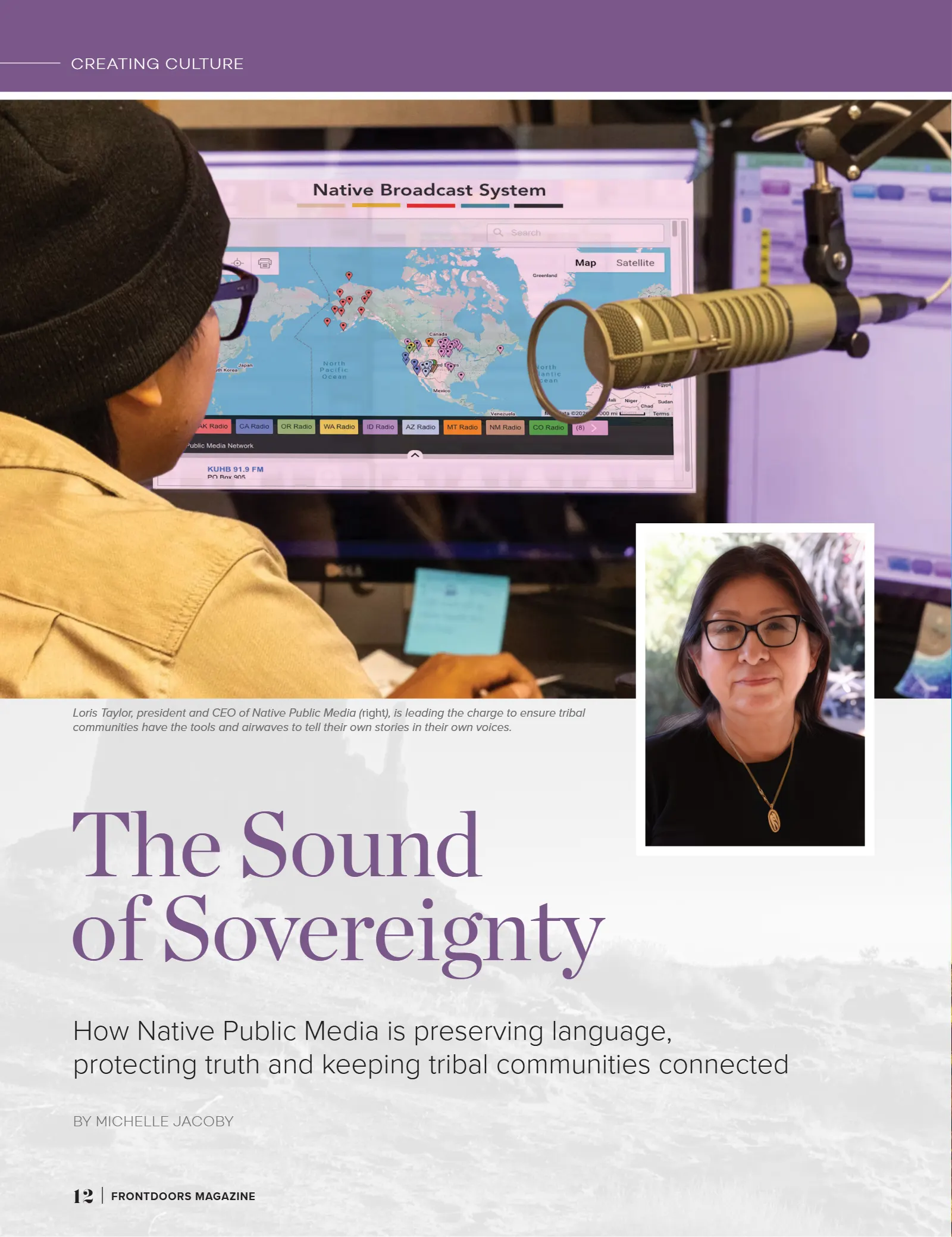
BY MICHELLE JACOBY How Native Public Media is preserving language, protecting truth and keeping tribal communities connected The Sound of Sovereignty Loris Taylor, president and CEO of Native Public Media ( right ), is leading the charge to ensure tribal communities have the tools and airwaves to tell their own stories in their own voices. 12 | FRONTDOORS MAGAZINE CREATING CULTURE
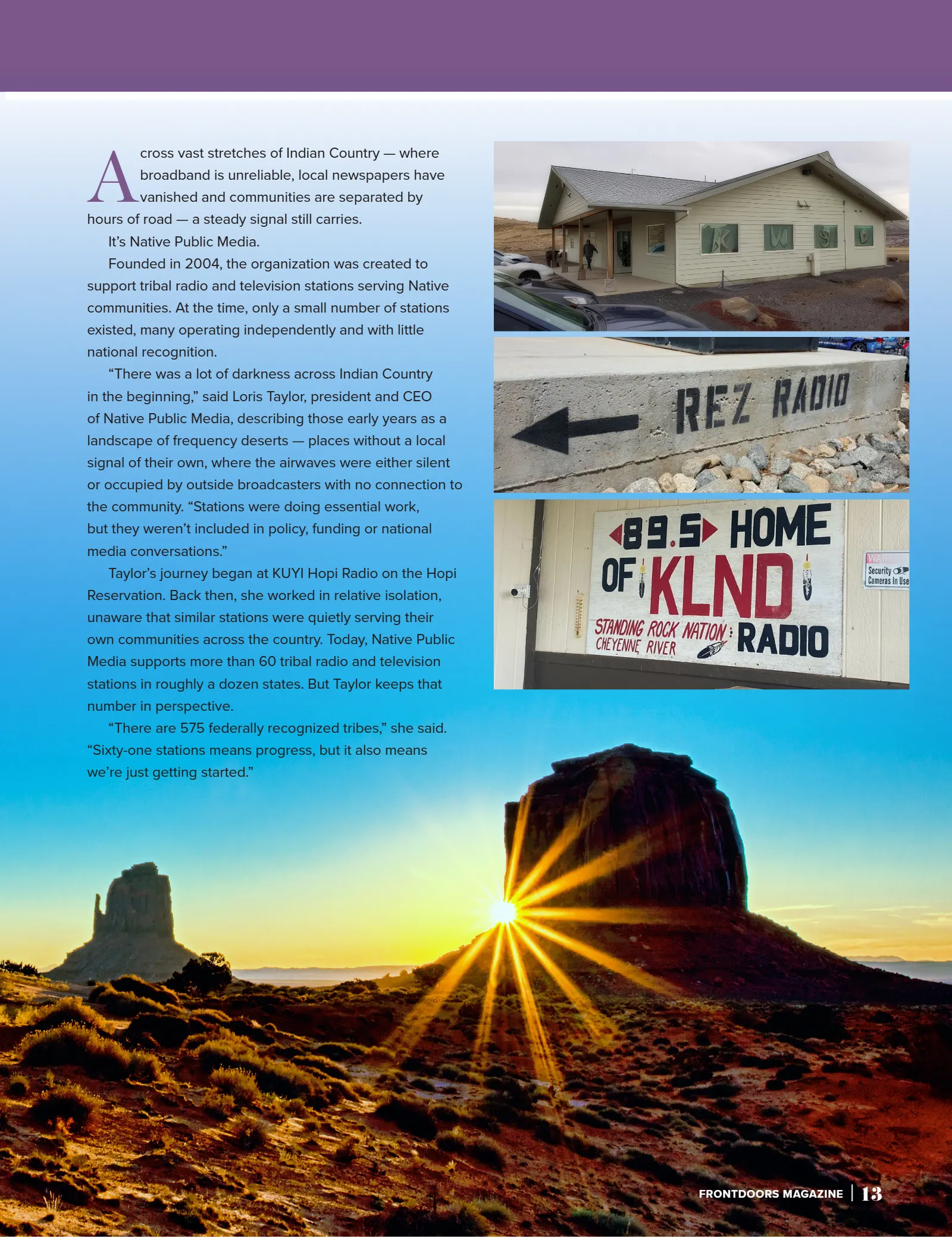
FRONTDOORS MAGAZINE | 13 cross vast stretches of Indian Country — where broadband is unreliable, local newspapers have vanished and communities are separated by hours of road — a steady signal still carries. It’s Native Public Media. Founded in 2004, the organization was created to support tribal radio and television stations serving Native communities. At the time, only a small number of stations existed, many operating independently and with little national recognition. “There was a lot of darkness across Indian Country in the beginning,” said Loris Taylor, president and CEO of Native Public Media, describing those early years as a landscape of frequency deserts — places without a local signal of their own, where the airwaves were either silent or occupied by outside broadcasters with no connection to the community. “Stations were doing essential work, but they weren’t included in policy, funding or national media conversations.” Taylor’s journey began at KUYI Hopi Radio on the Hopi Reservation. Back then, she worked in relative isolation, unaware that similar stations were quietly serving their own communities across the country. Today, Native Public Media supports more than 60 tribal radio and television stations in roughly a dozen states. But Taylor keeps that number in perspective. “There are 575 federally recognized tribes,” she said. “Sixty-one stations means progress, but it also means we’re just getting started.” A