
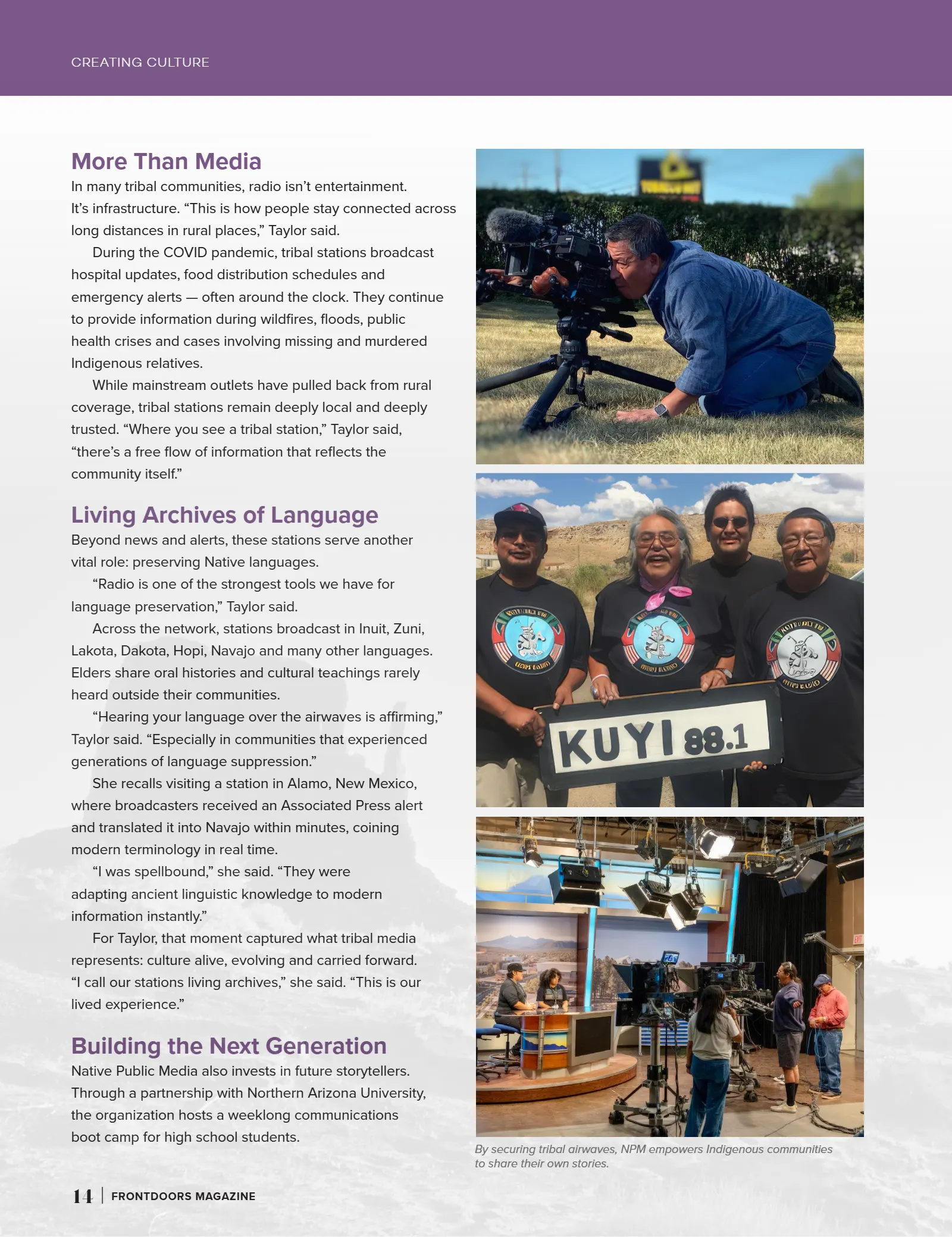
More Than Media In many tribal communities, radio isn’t entertainment. It’s infrastructure. “This is how people stay connected across long distances in rural places,” Taylor said. During the COVID pandemic, tribal stations broadcast hospital updates, food distribution schedules and emergency alerts — often around the clock. They continue to provide information during wildfires, floods, public health crises and cases involving missing and murdered Indigenous relatives. While mainstream outlets have pulled back from rural coverage, tribal stations remain deeply local and deeply trusted. “Where you see a tribal station,” Taylor said, “there’s a free flow of information that reflects the community itself.” Living Archives of Language Beyond news and alerts, these stations serve another vital role: preserving Native languages. “Radio is one of the strongest tools we have for language preservation,” Taylor said. Across the network, stations broadcast in Inuit, Zuni, Lakota, Dakota, Hopi, Navajo and many other languages. Elders share oral histories and cultural teachings rarely heard outside their communities. “Hearing your language over the airwaves is affirming,” Taylor said. “Especially in communities that experienced generations of language suppression.” She recalls visiting a station in Alamo, New Mexico, where broadcasters received an Associated Press alert and translated it into Navajo within minutes, coining modern terminology in real time. “I was spellbound,” she said. “They were adapting ancient linguistic knowledge to modern information instantly.” For Taylor, that moment captured what tribal media represents: culture alive, evolving and carried forward. “I call our stations living archives,” she said. “This is our lived experience.” Building the Next Generation Native Public Media also invests in future storytellers. Through a partnership with Northern Arizona University, the organization hosts a weeklong communications boot camp for high school students. CREATING CULTURE 14 | FRONTDOORS MAGAZINE By securing tribal airwaves, NPM empowers Indigenous communities to share their own stories.
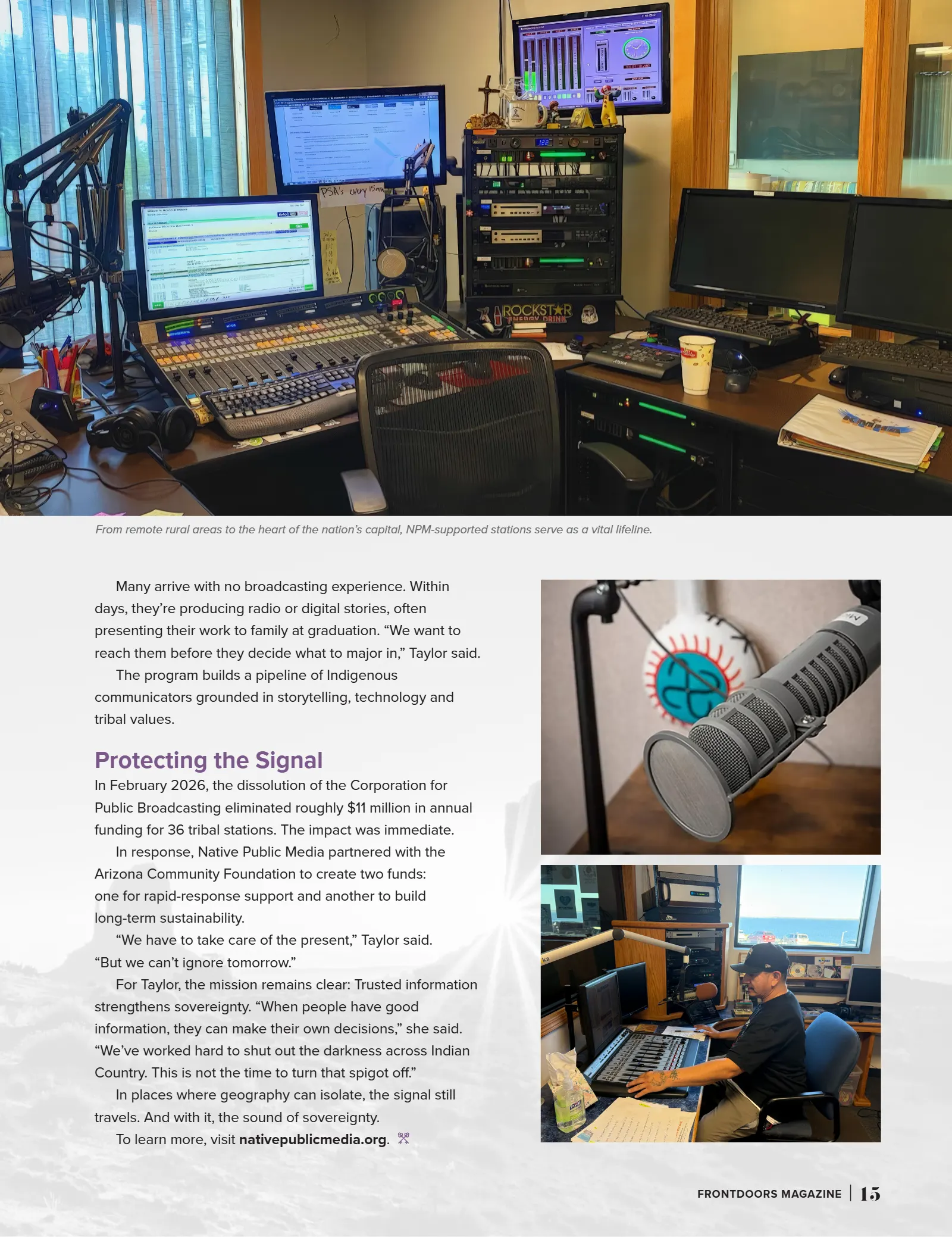
Many arrive with no broadcasting experience. Within days, they’re producing radio or digital stories, often presenting their work to family at graduation. “We want to reach them before they decide what to major in,” Taylor said. The program builds a pipeline of Indigenous communicators grounded in storytelling, technology and tribal values. Protecting the Signal In February 2026, the dissolution of the Corporation for Public Broadcasting eliminated roughly $11 million in annual funding for 36 tribal stations. The impact was immediate. In response, Native Public Media partnered with the Arizona Community Foundation to create two funds: one for rapid-response support and another to build long-term sustainability. “We have to take care of the present,” Taylor said. “But we can’t ignore tomorrow.” For Taylor, the mission remains clear: Trusted information strengthens sovereignty. “When people have good information, they can make their own decisions,” she said. “We’ve worked hard to shut out the darkness across Indian Country. This is not the time to turn that spigot off.” In places where geography can isolate, the signal still travels. And with it, the sound of sovereignty. To learn more, visit nativepublicmedia.org . FRONTDOORS MAGAZINE | 15 From remote rural areas to the heart of the nation’s capital, NPM-supported stations serve as a vital lifeline.