
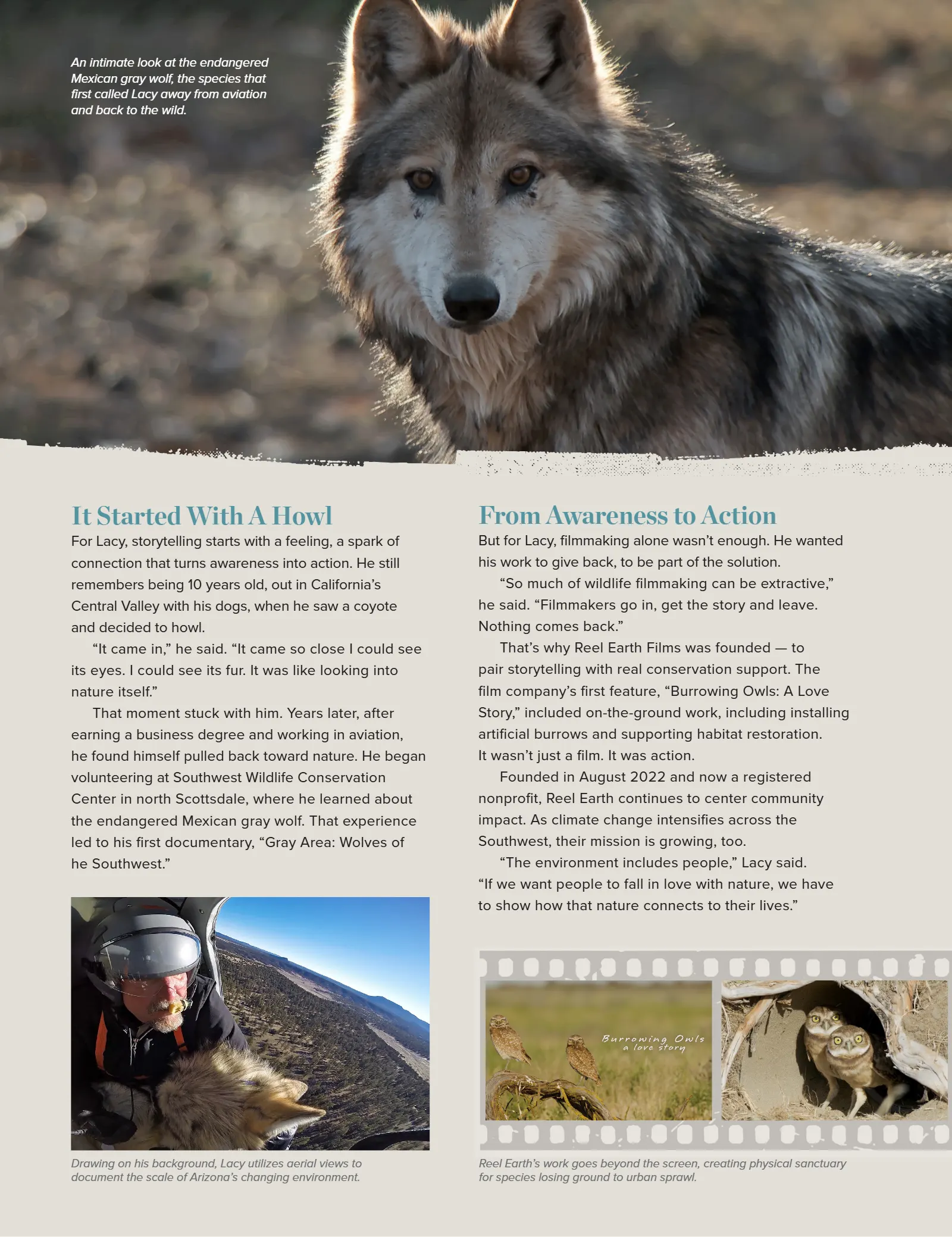
34 | FRONTDOORS MAGAZINE It Started With A Howl For Lacy, storytelling starts with a feeling, a spark of connection that turns awareness into action. He still remembers being 10 years old, out in California’s Central Valley with his dogs, when he saw a coyote and decided to howl. “It came in,” he said. “It came so close I could see its eyes. I could see its fur. It was like looking into nature itself.” That moment stuck with him. Years later, after earning a business degree and working in aviation, he found himself pulled back toward nature. He began volunteering at Southwest Wildlife Conservation Center in north Scottsdale, where he learned about the endangered Mexican gray wolf. That experience led to his first documentary, “Gray Area: Wolves of he Southwest.” From Awareness to Action But for Lacy, filmmaking alone wasn’t enough. He wanted his work to give back, to be part of the solution. “So much of wildlife filmmaking can be extractive,” he said. “Filmmakers go in, get the story and leave. Nothing comes back.” That’s why Reel Earth Films was founded — to pair storytelling with real conservation support. The film company’s first feature, “Burrowing Owls: A Love Story,” included on-the-ground work, including installing artificial burrows and supporting habitat restoration. It wasn’t just a film. It was action. Founded in August 2022 and now a registered nonprofit, Reel Earth continues to center community impact. As climate change intensifies across the Southwest, their mission is growing, too. “The environment includes people,” Lacy said. “If we want people to fall in love with nature, we have to show how that nature connects to their lives.” An intimate look at the endangered Mexican gray wolf, the species that first called Lacy away from aviation and back to the wild. Reel Earth’s work goes beyond the screen, creating physical sanctuary for species losing ground to urban sprawl. Drawing on his background, Lacy utilizes aerial views to document the scale of Arizona’s changing environment.
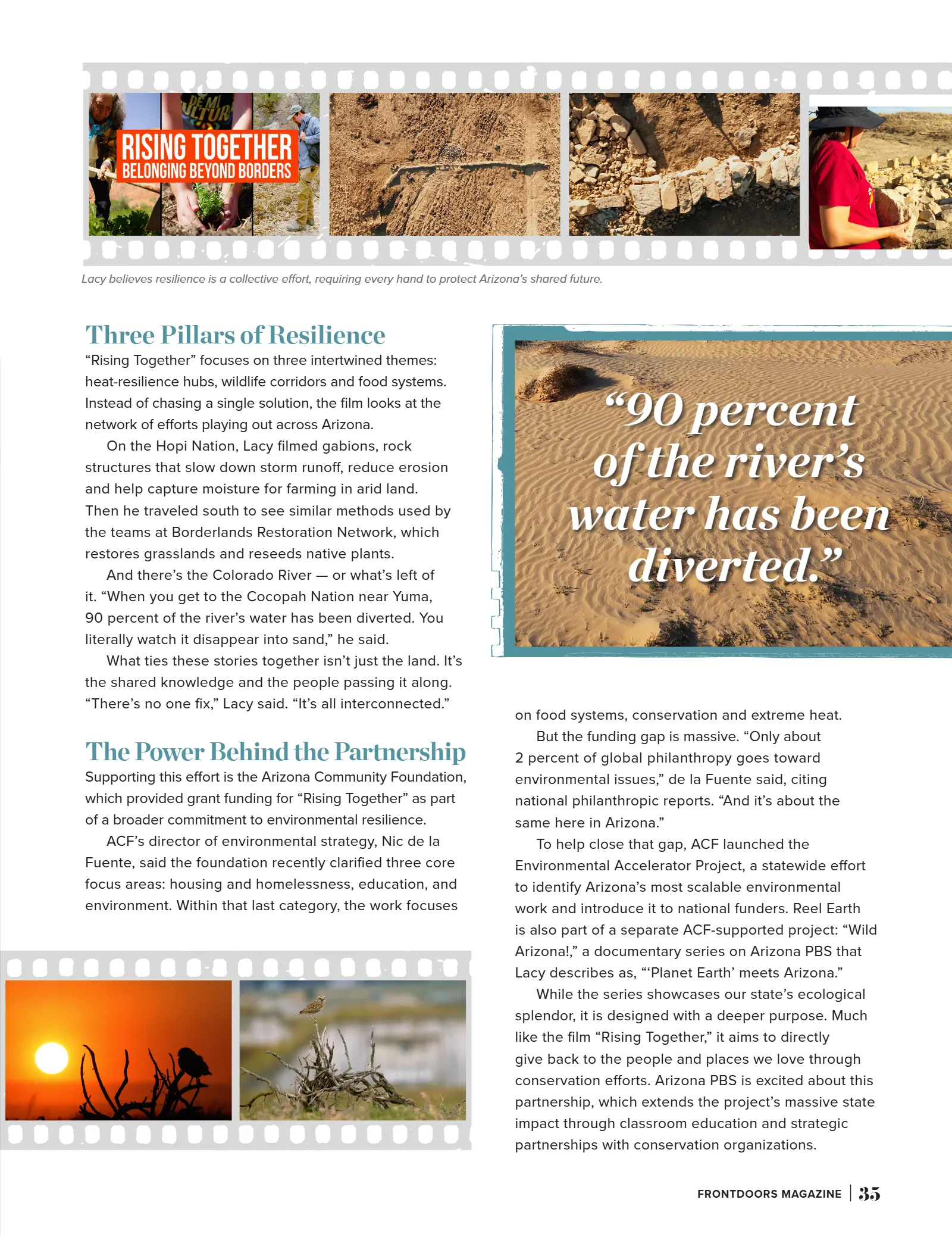
FRONTDOORS MAGAZINE | 35 Three Pillars of Resilience “Rising Together” focuses on three intertwined themes: heat-resilience hubs, wildlife corridors and food systems. Instead of chasing a single solution, the film looks at the network of efforts playing out across Arizona. On the Hopi Nation, Lacy filmed gabions, rock structures that slow down storm runoff, reduce erosion and help capture moisture for farming in arid land. Then he traveled south to see similar methods used by the teams at Borderlands Restoration Network, which restores grasslands and reseeds native plants. And there’s the Colorado River — or what’s left of it. “When you get to the Cocopah Nation near Yuma, 90 percent of the river’s water has been diverted. You literally watch it disappear into sand,” he said. What ties these stories together isn’t just the land. It’s the shared knowledge and the people passing it along. “There’s no one fix,” Lacy said. “It’s all interconnected.” The Power Behind the Partnership Supporting this effort is the Arizona Community Foundation, which provided grant funding for “Rising Together” as part of a broader commitment to environmental resilience. ACF’s director of environmental strategy, Nic de la Fuente, said the foundation recently clarified three core focus areas: housing and homelessness, education, and environment. Within that last category, the work focuses on food systems, conservation and extreme heat. But the funding gap is massive. “Only about 2 percent of global philanthropy goes toward environmental issues,” de la Fuente said, citing national philanthropic reports. “And it’s about the same here in Arizona.” To help close that gap, ACF launched the Environmental Accelerator Project, a statewide effort to identify Arizona’s most scalable environmental work and introduce it to national funders. Reel Earth is also part of a separate ACF-supported project: “Wild Arizona!,” a documentary series on Arizona PBS that Lacy describes as, “‘Planet Earth’ meets Arizona.” While the series showcases our state’s ecological splendor, it is designed with a deeper purpose. Much like the film “Rising Together,” it aims to directly give back to the people and places we love through conservation efforts. Arizona PBS is excited about this partnership, which extends the project’s massive state impact through classroom education and strategic partnerships with conservation organizations. Lacy believes resilience is a collective effort, requiring every hand to protect Arizona’s shared future. “90 percent of the river’s water has been diverted.”