
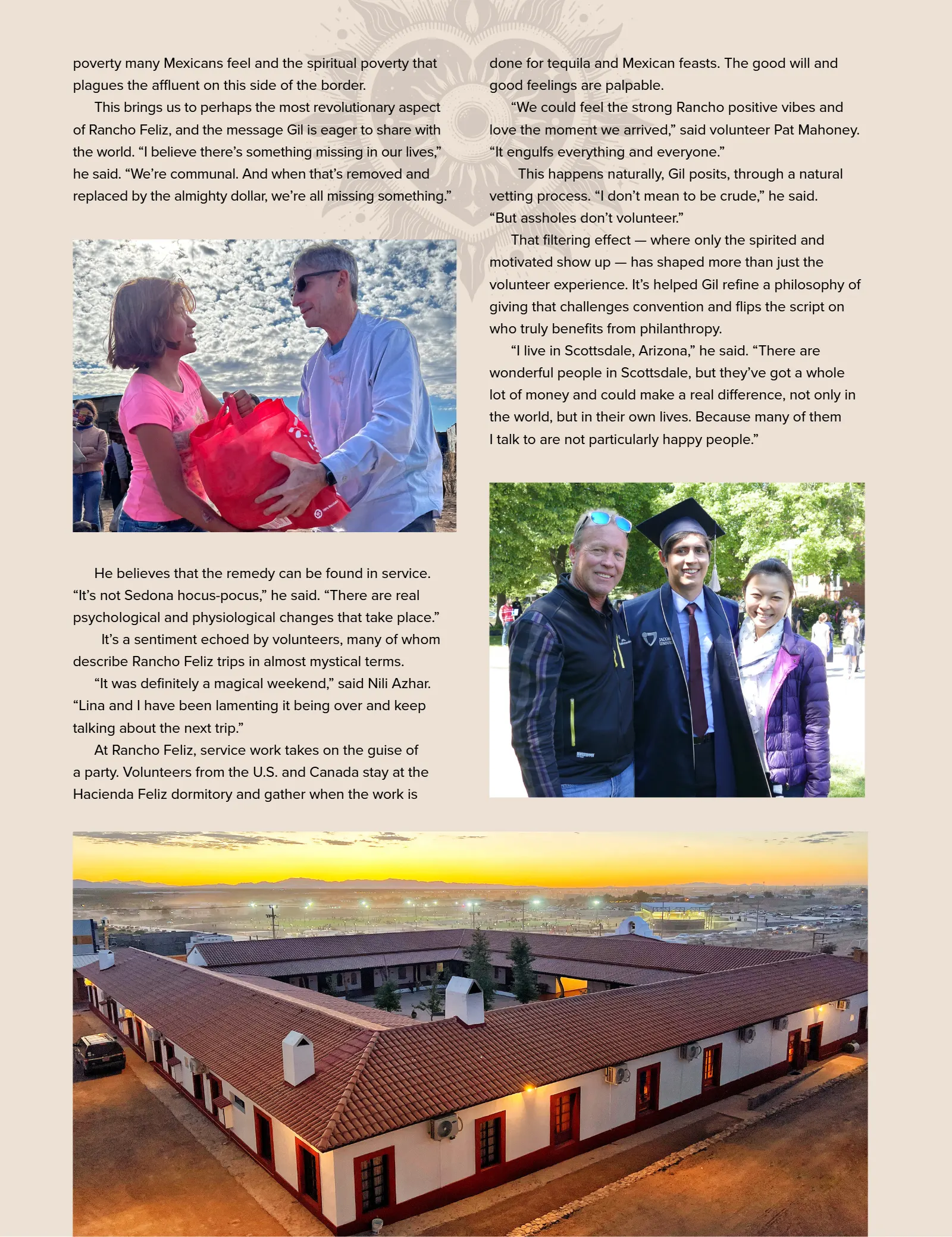
done for tequila and Mexican feasts. The good will and good feelings are palpable. “We could feel the strong Rancho positive vibes and love the moment we arrived,” said volunteer Pat Mahoney. “It engulfs everything and everyone.” This happens naturally, Gil posits, through a natural vetting process. “I don’t mean to be crude,” he said. “But assholes don’t volunteer.” That filtering effect — where only the spirited and motivated show up — has shaped more than just the volunteer experience. It’s helped Gil refine a philosophy of giving that challenges convention and flips the script on who truly benefits from philanthropy. “I live in Scottsdale, Arizona,” he said. “There are wonderful people in Scottsdale, but they’ve got a whole lot of money and could make a real difference, not only in the world, but in their own lives. Because many of them I talk to are not particularly happy people.” poverty many Mexicans feel and the spiritual poverty that plagues the affluent on this side of the border. This brings us to perhaps the most revolutionary aspect of Rancho Feliz, and the message Gil is eager to share with the world. “I believe there’s something missing in our lives,” he said. “We’re communal. And when that’s removed and replaced by the almighty dollar, we’re all missing something.” He believes that the remedy can be found in service. “It’s not Sedona hocus-pocus,” he said. “There are real psychological and physiological changes that take place.” It’s a sentiment echoed by volunteers, many of whom describe Rancho Feliz trips in almost mystical terms. “It was definitely a magical weekend,” said Nili Azhar. “Lina and I have been lamenting it being over and keep talking about the next trip.” At Rancho Feliz, service work takes on the guise of a party. Volunteers from the U.S. and Canada stay at the Hacienda Feliz dormitory and gather when the work is
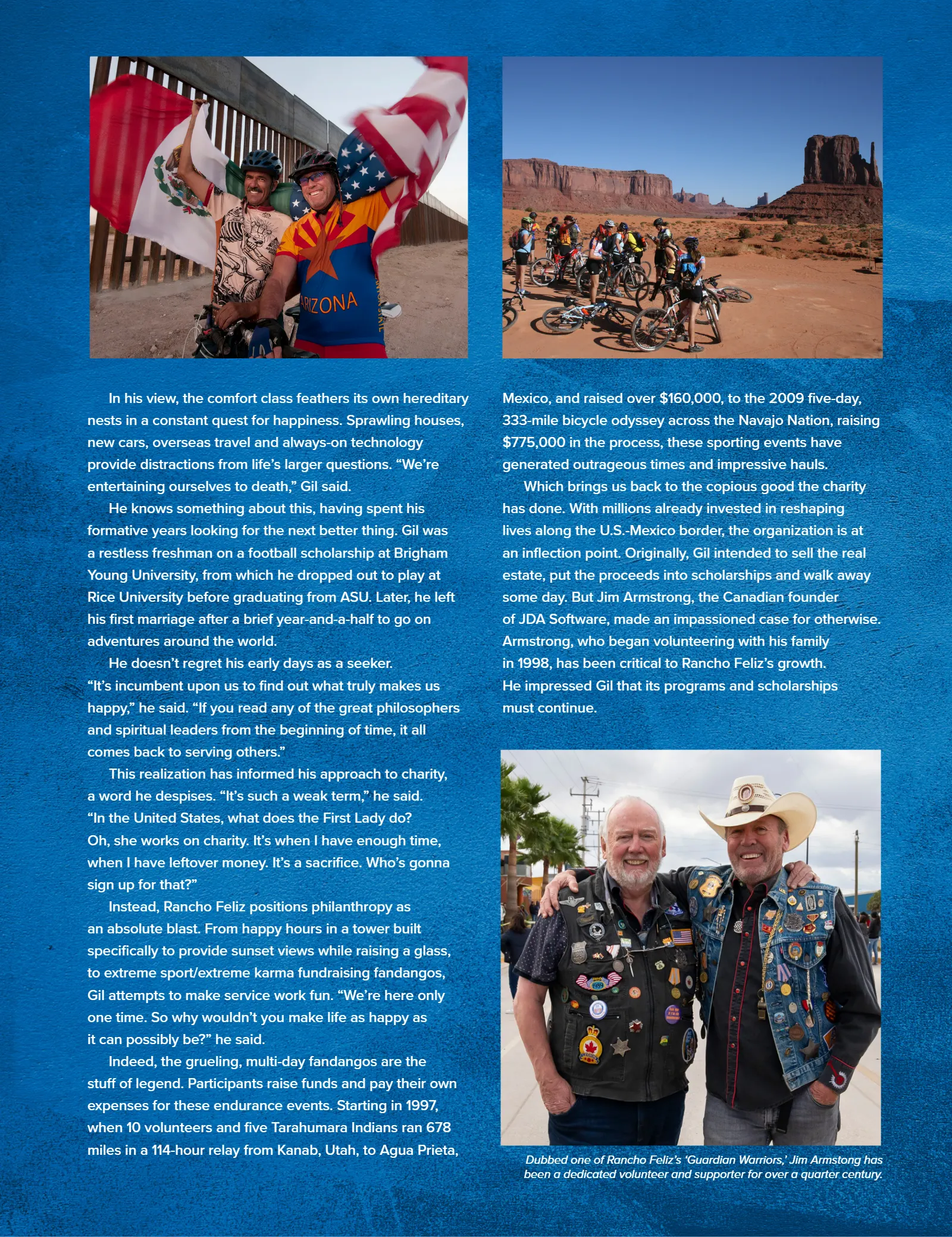
Dubbed one of Rancho Feliz’s ‘Guardian Warriors,’ Jim Armstong has been a dedicated volunteer and supporter for over a quarter century. In his view, the comfort class feathers its own hereditary nests in a constant quest for happiness. Sprawling houses, new cars, overseas travel and always-on technology provide distractions from life’s larger questions. “We’re entertaining ourselves to death,” Gil said. He knows something about this, having spent his formative years looking for the next better thing. Gil was a restless freshman on a football scholarship at Brigham Young University, from which he dropped out to play at Rice University before graduating from ASU. Later, he left his first marriage after a brief year-and-a-half to go on adventures around the world. He doesn’t regret his early days as a seeker. “It’s incumbent upon us to find out what truly makes us happy,” he said. “If you read any of the great philosophers and spiritual leaders from the beginning of time, it all comes back to serving others.” This realization has informed his approach to charity, a word he despises. “It’s such a weak term,” he said. “In the United States, what does the First Lady do? Oh, she works on charity. It’s when I have enough time, when I have leftover money. It’s a sacrifice. Who’s gonna sign up for that?” Instead, Rancho Feliz positions philanthropy as an absolute blast. From happy hours in a tower built specifically to provide sunset views while raising a glass, to extreme sport/extreme karma fundraising fandangos, Gil attempts to make service work fun. “We’re here only one time. So why wouldn’t you make life as happy as it can possibly be?” he said. Indeed, the grueling, multi-day fandangos are the stuff of legend. Participants raise funds and pay their own expenses for these endurance events. Starting in 1997, when 10 volunteers and five Tarahumara Indians ran 678 miles in a 114-hour relay from Kanab, Utah, to Agua Prieta, Mexico, and raised over $160,000, to the 2009 five-day, 333-mile bicycle odyssey across the Navajo Nation, raising $775,000 in the process, these sporting events have generated outrageous times and impressive hauls. Which brings us back to the copious good the charity has done. With millions already invested in reshaping lives along the U.S.-Mexico border, the organization is at an inflection point. Originally, Gil intended to sell the real estate, put the proceeds into scholarships and walk away some day. But Jim Armstrong, the Canadian founder of JDA Software, made an impassioned case for otherwise. Armstrong, who began volunteering with his family in 1998, has been critical to Rancho Feliz’s growth. He impressed Gil that its programs and scholarships must continue.