
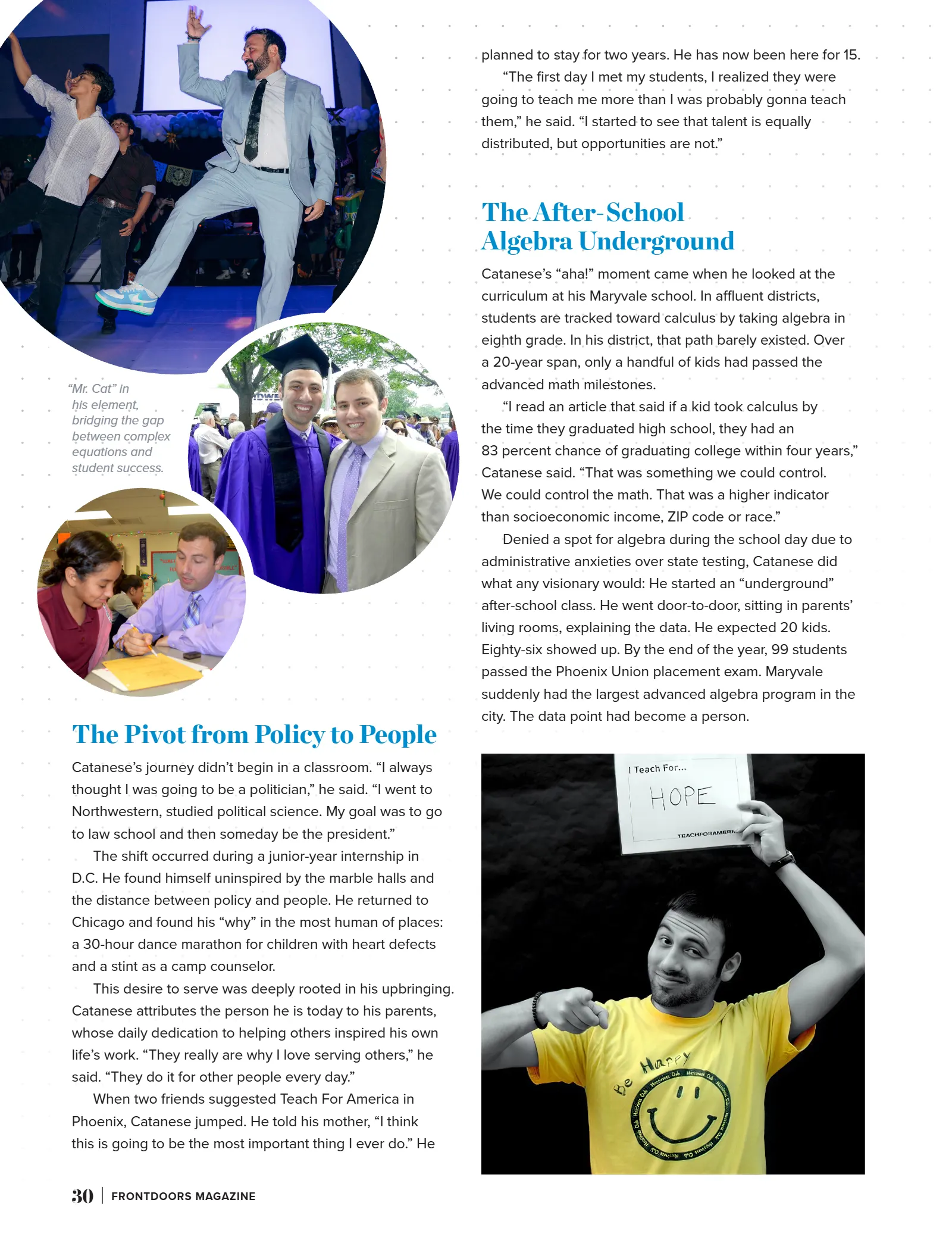
The Pivot from Policy to People Catanese’s journey didn’t begin in a classroom. “I always thought I was going to be a politician,” he said. “I went to Northwestern, studied political science. My goal was to go to law school and then someday be the president.” The shift occurred during a junior-year internship in D.C. He found himself uninspired by the marble halls and the distance between policy and people. He returned to Chicago and found his “why” in the most human of places: a 30-hour dance marathon for children with heart defects and a stint as a camp counselor. This desire to serve was deeply rooted in his upbringing. Catanese attributes the person he is today to his parents, whose daily dedication to helping others inspired his own life’s work. “They really are why I love serving others,” he said. “They do it for other people every day.” When two friends suggested Teach For America in Phoenix, Catanese jumped. He told his mother, “I think this is going to be the most important thing I ever do.” He planned to stay for two years. He has now been here for 15. “The first day I met my students, I realized they were going to teach me more than I was probably gonna teach them,” he said. “I started to see that talent is equally distributed, but opportunities are not.” The After-School Algebra Underground Catanese’s “aha!” moment came when he looked at the curriculum at his Maryvale school. In affluent districts, students are tracked toward calculus by taking algebra in eighth grade. In his district, that path barely existed. Over a 20-year span, only a handful of kids had passed the advanced math milestones. “I read an article that said if a kid took calculus by the time they graduated high school, they had an 83 percent chance of graduating college within four years,” Catanese said. “That was something we could control. We could control the math. That was a higher indicator than socioeconomic income, ZIP code or race.” Denied a spot for algebra during the school day due to administrative anxieties over state testing, Catanese did what any visionary would: He started an “underground” after-school class. He went door-to-door, sitting in parents’ living rooms, explaining the data. He expected 20 kids. Eighty-six showed up. By the end of the year, 99 students passed the Phoenix Union placement exam. Maryvale suddenly had the largest advanced algebra program in the city. The data point had become a person. “ Mr. Cat” in his element, bridging the gap between complex equations and student success. 30 | FRONTDOORS MAGAZINE
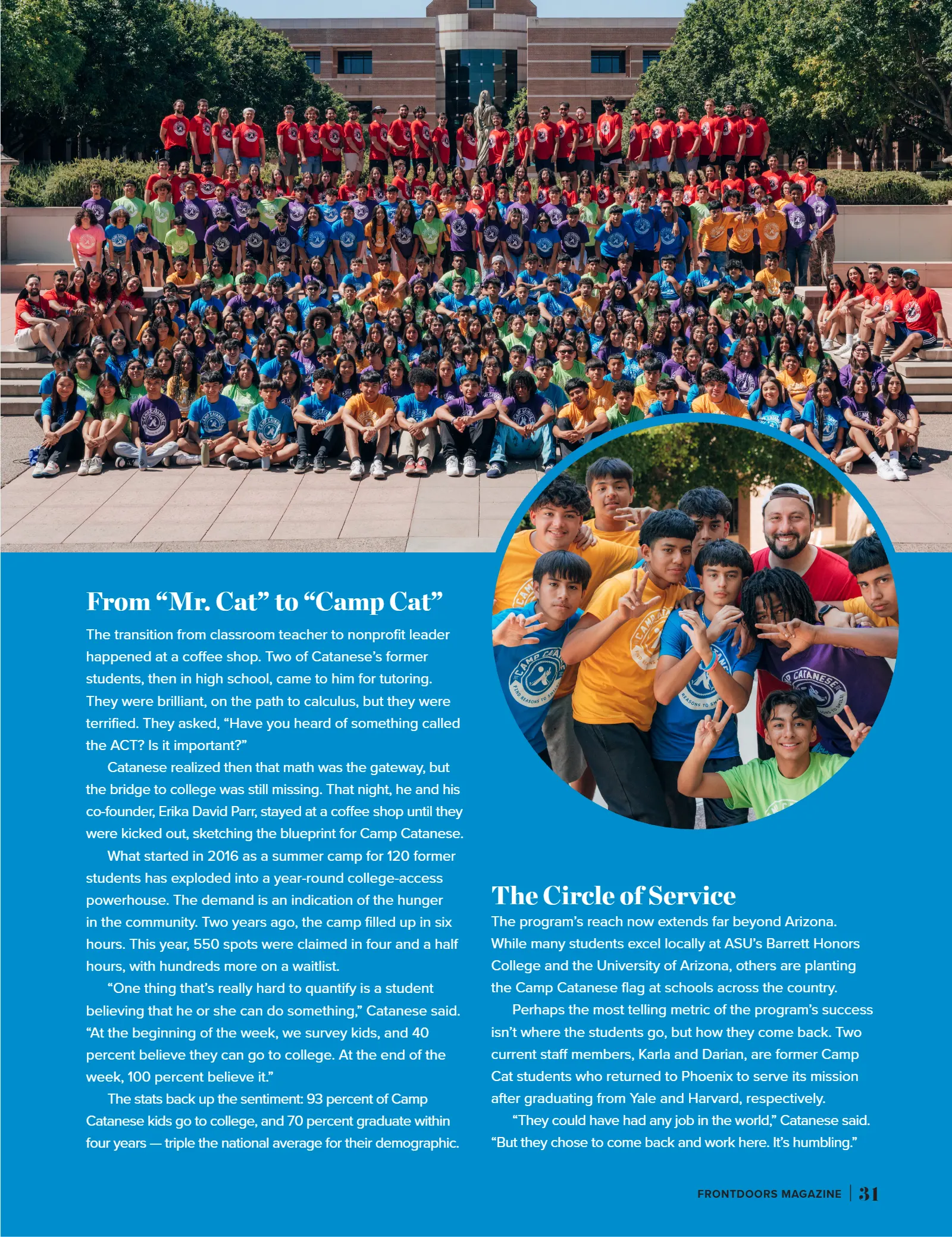
From “Mr. Cat” to “Camp Cat” The transition from classroom teacher to nonprofit leader happened at a coffee shop. Two of Catanese’s former students, then in high school, came to him for tutoring. They were brilliant, on the path to calculus, but they were terrified. They asked, “Have you heard of something called the ACT? Is it important?” Catanese realized then that math was the gateway, but the bridge to college was still missing. That night, he and his co-founder, Erika David Parr, stayed at a coffee shop until they were kicked out, sketching the blueprint for Camp Catanese. What started in 2016 as a summer camp for 120 former students has exploded into a year-round college-access powerhouse. The demand is an indication of the hunger in the community. Two years ago, the camp filled up in six hours. This year, 550 spots were claimed in four and a half hours, with hundreds more on a waitlist. “One thing that’s really hard to quantify is a student believing that he or she can do something,” Catanese said. “At the beginning of the week, we survey kids, and 40 percent believe they can go to college. At the end of the week, 100 percent believe it.” The stats back up the sentiment: 93 percent of Camp Catanese kids go to college, and 70 percent graduate within four years — triple the national average for their demographic. The Circle of Service The program’s reach now extends far beyond Arizona. While many students excel locally at ASU’s Barrett Honors College and the University of Arizona, others are planting the Camp Catanese flag at schools across the country. Perhaps the most telling metric of the program’s success isn’t where the students go, but how they come back. Two current staff members, Karla and Darian, are former Camp Cat students who returned to Phoenix to serve its mission after graduating from Yale and Harvard, respectively. “They could have had any job in the world,” Catanese said. “But they chose to come back and work here. It’s humbling.” FRONTDOORS MAGAZINE | 31