
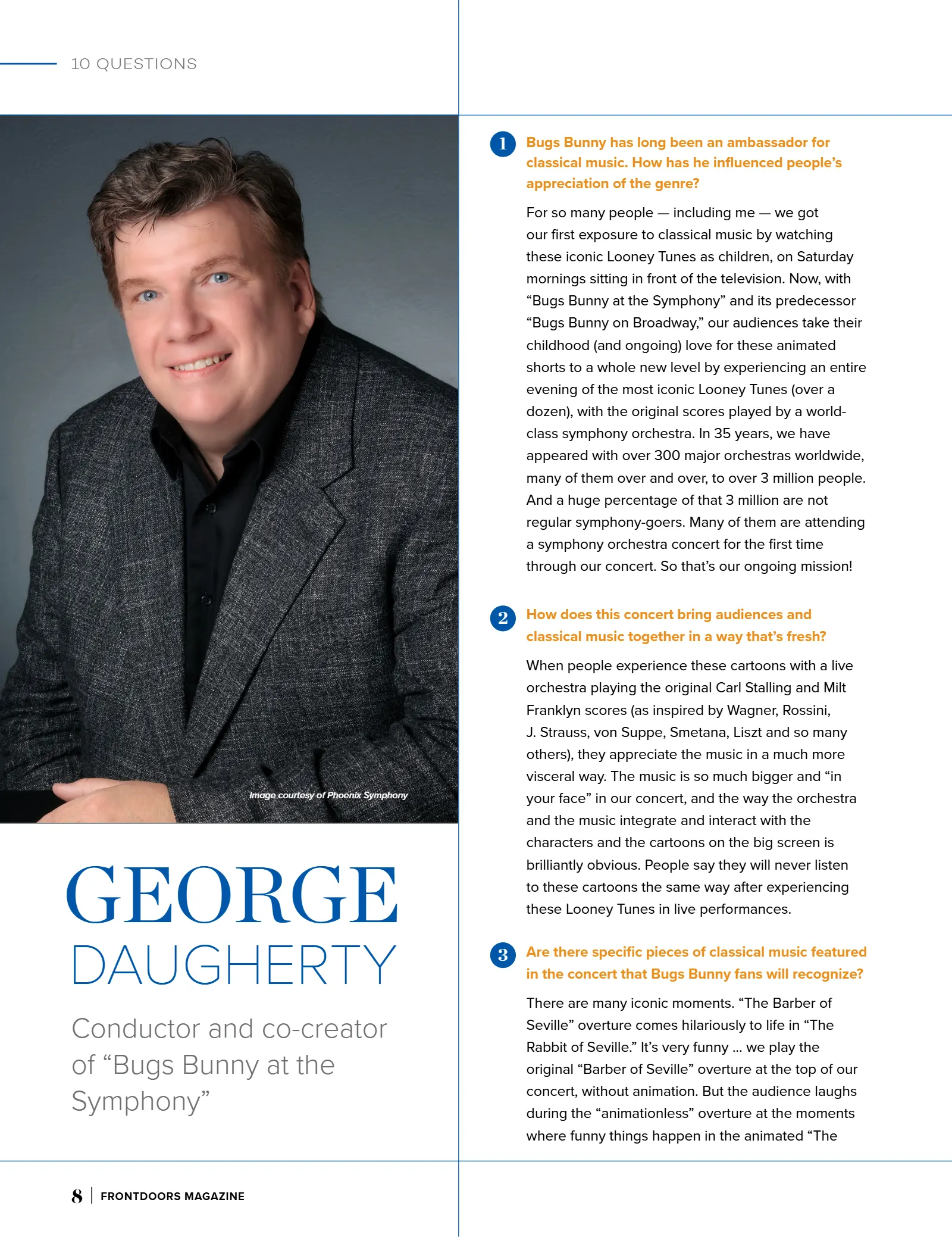
8 | FRONTDOORS MAGAZINE 2 3 Bugs Bunny has long been an ambassador for classical music. How has he influenced people’s appreciation of the genre? For so many people — including me — we got our first exposure to classical music by watching these iconic Looney Tunes as children, on Saturday mornings sitting in front of the television. Now, with “Bugs Bunny at the Symphony” and its predecessor “Bugs Bunny on Broadway,” our audiences take their childhood (and ongoing) love for these animated shorts to a whole new level by experiencing an entire evening of the most iconic Looney Tunes (over a dozen), with the original scores played by a world- class symphony orchestra. In 35 years, we have appeared with over 300 major orchestras worldwide, many of them over and over, to over 3 million people. And a huge percentage of that 3 million are not regular symphony-goers. Many of them are attending a symphony orchestra concert for the first time through our concert. So that’s our ongoing mission! How does this concert bring audiences and classical music together in a way that’s fresh? When people experience these cartoons with a live orchestra playing the original Carl Stalling and Milt Franklyn scores (as inspired by Wagner, Rossini, J. Strauss, von Suppe, Smetana, Liszt and so many others), they appreciate the music in a much more visceral way. The music is so much bigger and “in your face” in our concert, and the way the orchestra and the music integrate and interact with the characters and the cartoons on the big screen is brilliantly obvious. People say they will never listen to these cartoons the same way after experiencing these Looney Tunes in live performances. Are there specific pieces of classical music featured in the concert that Bugs Bunny fans will recognize? There are many iconic moments. “The Barber of Seville” overture comes hilariously to life in “The Rabbit of Seville.” It’s very funny ... we play the original “Barber of Seville” overture at the top of our concert, without animation. But the audience laughs during the “animationless” overture at the moments where funny things happen in the animated “The 1 GEORGE Conductor and co-creator of “Bugs Bunny at the Symphony” DAUGHERTY Image courtesy of Phoenix Symphony 10 QUESTIONS
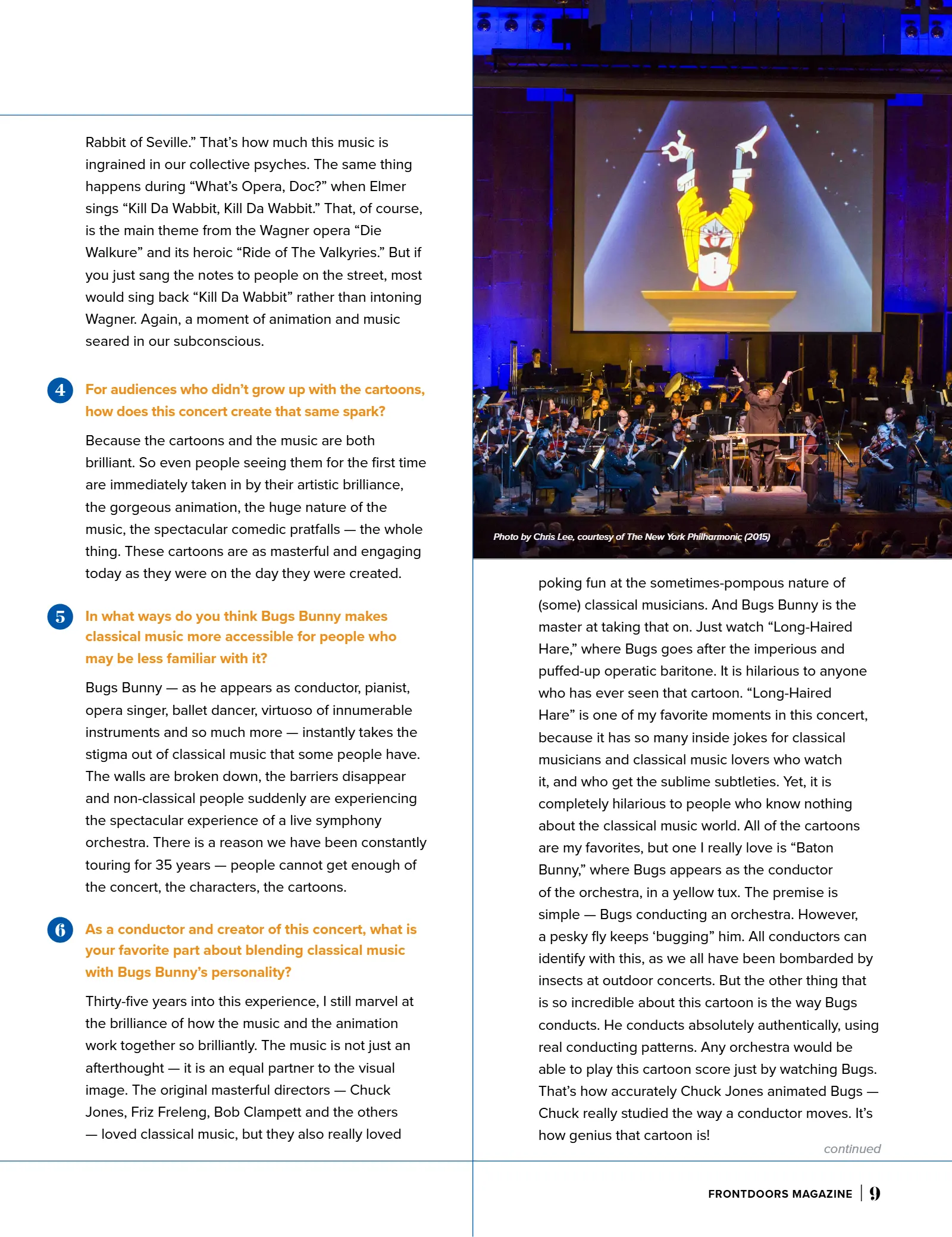
FRONTDOORS MAGAZINE | 9 Rabbit of Seville.” That’s how much this music is ingrained in our collective psyches. The same thing happens during “What’s Opera, Doc?” when Elmer sings “Kill Da Wabbit, Kill Da Wabbit.” That, of course, is the main theme from the Wagner opera “Die Walkure” and its heroic “Ride of The Valkyries.” But if you just sang the notes to people on the street, most would sing back “Kill Da Wabbit” rather than intoning Wagner. Again, a moment of animation and music seared in our subconscious. For audiences who didn’t grow up with the cartoons, how does this concert create that same spark? Because the cartoons and the music are both brilliant. So even people seeing them for the first time are immediately taken in by their artistic brilliance, the gorgeous animation, the huge nature of the music, the spectacular comedic pratfalls — the whole thing. These cartoons are as masterful and engaging today as they were on the day they were created. In what ways do you think Bugs Bunny makes classical music more accessible for people who may be less familiar with it? Bugs Bunny — as he appears as conductor, pianist, opera singer, ballet dancer, virtuoso of innumerable instruments and so much more — instantly takes the stigma out of classical music that some people have. The walls are broken down, the barriers disappear and non-classical people suddenly are experiencing the spectacular experience of a live symphony orchestra. There is a reason we have been constantly touring for 35 years — people cannot get enough of the concert, the characters, the cartoons. As a conductor and creator of this concert, what is your favorite part about blending classical music with Bugs Bunny’s personality? Thirty-five years into this experience, I still marvel at the brilliance of how the music and the animation work together so brilliantly. The music is not just an afterthought — it is an equal partner to the visual image. The original masterful directors — Chuck Jones, Friz Freleng, Bob Clampett and the others — loved classical music, but they also really loved poking fun at the sometimes-pompous nature of (some) classical musicians. And Bugs Bunny is the master at taking that on. Just watch “Long-Haired Hare,” where Bugs goes after the imperious and puffed-up operatic baritone. It is hilarious to anyone who has ever seen that cartoon. “Long-Haired Hare” is one of my favorite moments in this concert, because it has so many inside jokes for classical musicians and classical music lovers who watch it, and who get the sublime subtleties. Yet, it is completely hilarious to people who know nothing about the classical music world. All of the cartoons are my favorites, but one I really love is “Baton Bunny,” where Bugs appears as the conductor of the orchestra, in a yellow tux. The premise is simple — Bugs conducting an orchestra. However, a pesky fly keeps ‘bugging” him. All conductors can identify with this, as we all have been bombarded by insects at outdoor concerts. But the other thing that is so incredible about this cartoon is the way Bugs conducts. He conducts absolutely authentically, using real conducting patterns. Any orchestra would be able to play this cartoon score just by watching Bugs. That’s how accurately Chuck Jones animated Bugs — Chuck really studied the way a conductor moves. It’s how genius that cartoon is! continued 4 5 6 Photo by Chris Lee, courtesy of The New York Philharmonic (2015)