
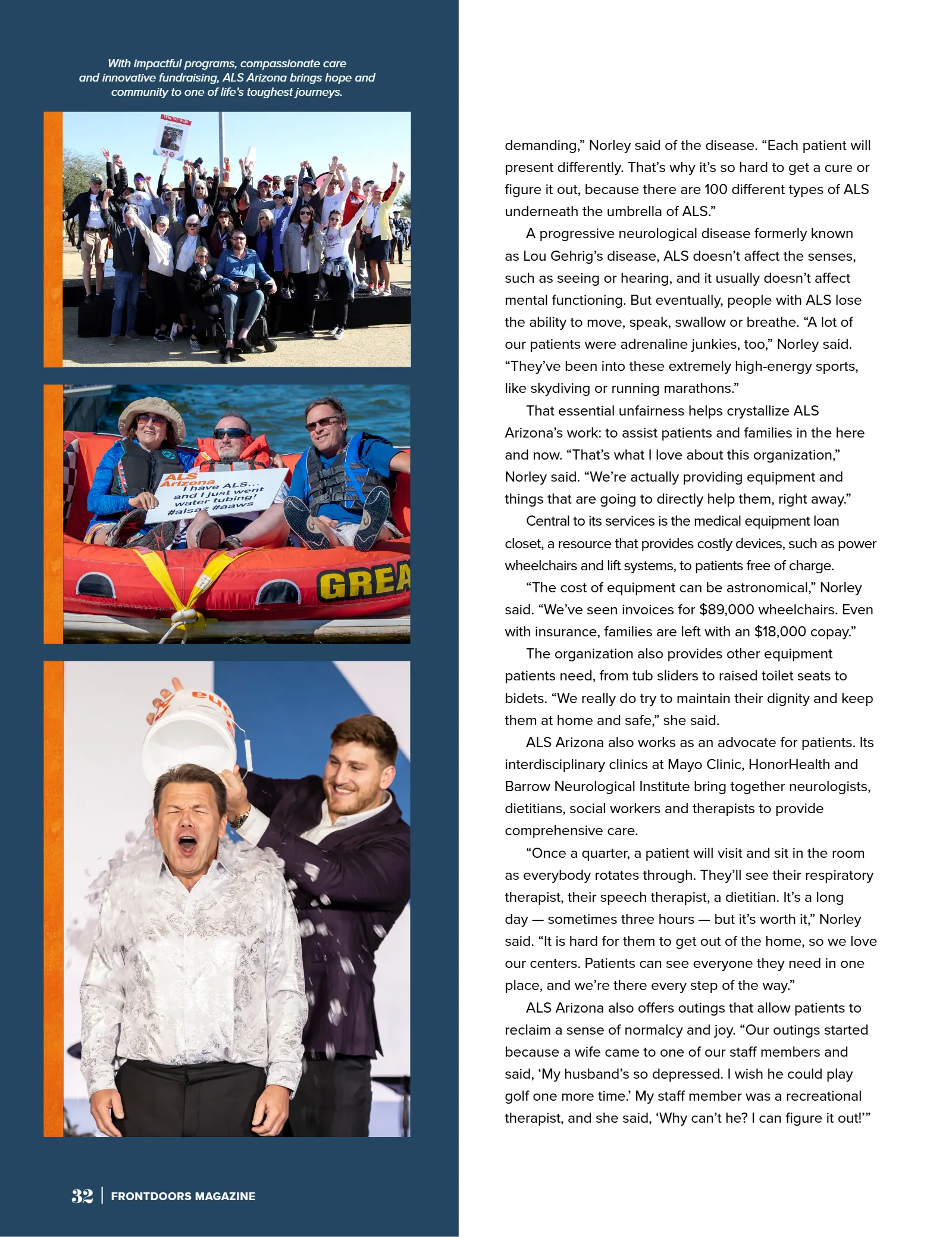
32 | FRONTDOORS MAGAZINE 32 | FRONTDOORS MAGAZINE demanding,” Norley said of the disease. “Each patient will present differently. That’s why it’s so hard to get a cure or figure it out, because there are 100 different types of ALS underneath the umbrella of ALS.” A progressive neurological disease formerly known as Lou Gehrig’s disease, ALS doesn’t affect the senses, such as seeing or hearing, and it usually doesn’t affect mental functioning. But eventually, people with ALS lose the ability to move, speak, swallow or breathe. “A lot of our patients were adrenaline junkies, too,” Norley said. “They’ve been into these extremely high-energy sports, like skydiving or running marathons.” That essential unfairness helps crystallize ALS Arizona’s work: to assist patients and families in the here and now. “That’s what I love about this organization,” Norley said. “We’re actually providing equipment and things that are going to directly help them, right away.” Central to its services is the medical equipment loan closet, a resource that provides costly devices, such as power wheelchairs and lift systems, to patients free of charge. “The cost of equipment can be astronomical,” Norley said. “We’ve seen invoices for $89,000 wheelchairs. Even with insurance, families are left with an $18,000 copay.” The organization also provides other equipment patients need, from tub sliders to raised toilet seats to bidets. “We really do try to maintain their dignity and keep them at home and safe,” she said. ALS Arizona also works as an advocate for patients. Its interdisciplinary clinics at Mayo Clinic, HonorHealth and Barrow Neurological Institute bring together neurologists, dietitians, social workers and therapists to provide comprehensive care. “Once a quarter, a patient will visit and sit in the room as everybody rotates through. They’ll see their respiratory therapist, their speech therapist, a dietitian. It’s a long day — sometimes three hours — but it’s worth it,” Norley said. “It is hard for them to get out of the home, so we love our centers. Patients can see everyone they need in one place, and we’re there every step of the way.” ALS Arizona also offers outings that allow patients to reclaim a sense of normalcy and joy. “Our outings started because a wife came to one of our staff members and said, ‘My husband’s so depressed. I wish he could play golf one more time.’ My staff member was a recreational therapist, and she said, ‘Why can’t he? I can figure it out!’” With impactful programs, compassionate care and innovative fundraising, ALS Arizona brings hope and community to one of life’s toughest journeys.
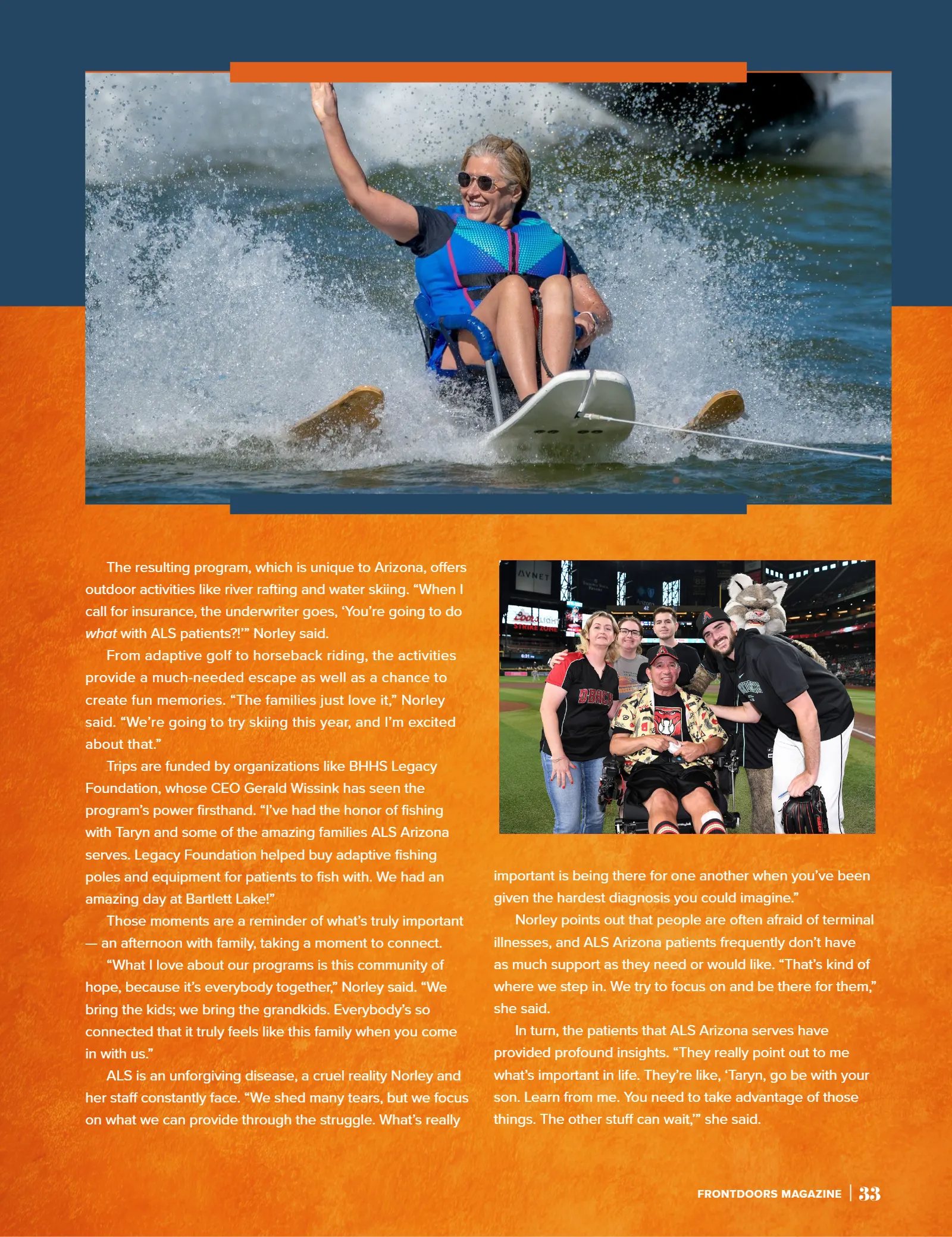
FRONTDOORS MAGAZINE | 33 The resulting program, which is unique to Arizona, offers outdoor activities like river rafting and water skiing. “When I call for insurance, the underwriter goes, ‘You’re going to do what with ALS patients?!’” Norley said. From adaptive golf to horseback riding, the activities provide a much-needed escape as well as a chance to create fun memories. “The families just love it,” Norley said. “We’re going to try skiing this year, and I’m excited about that.” Trips are funded by organizations like BHHS Legacy Foundation, whose CEO Gerald Wissink has seen the program’s power firsthand. “I’ve had the honor of fishing with Taryn and some of the amazing families ALS Arizona serves. Legacy Foundation helped buy adaptive fishing poles and equipment for patients to fish with. We had an amazing day at Bartlett Lake!” Those moments are a reminder of what’s truly important — an afternoon with family, taking a moment to connect. “What I love about our programs is this community of hope, because it’s everybody together,” Norley said. “We bring the kids; we bring the grandkids. Everybody’s so connected that it truly feels like this family when you come in with us.” ALS is an unforgiving disease, a cruel reality Norley and her staff constantly face. “We shed many tears, but we focus on what we can provide through the struggle. What’s really important is being there for one another when you’ve been given the hardest diagnosis you could imagine.” Norley points out that people are often afraid of terminal illnesses, and ALS Arizona patients frequently don’t have as much support as they need or would like. “That’s kind of where we step in. We try to focus on and be there for them,” she said. In turn, the patients that ALS Arizona serves have provided profound insights. “They really point out to me what’s important in life. They’re like, ‘Taryn, go be with your son. Learn from me. You need to take advantage of those things. The other stuff can wait,’” she said. FRONTDOORS MAGAZINE | 33