
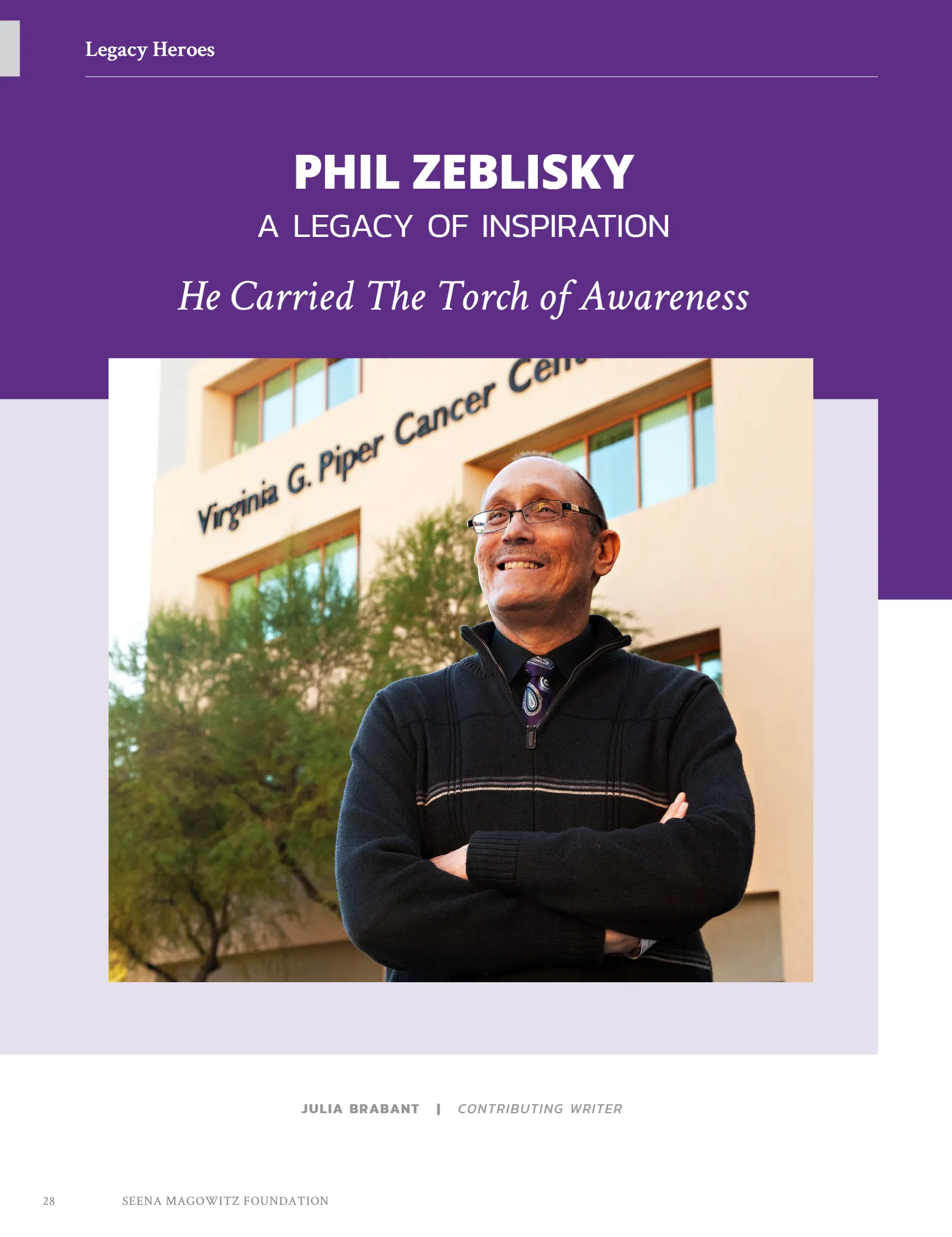
28 SEENA MAGOWITZ FOUNDATION JULIA BRABANT | CONTRI BUTI NG WRITER PHIL ZEBLISKY A LEGACY OF INSPIRATION He Carried The Torch of Awareness Legacy Heroes
SEENA MAGOWITZ FOUNDATION 29 Legacy Heroes The one-time certified public accountant-turned tireless cancer research advocate first learned of his Stage 4 pancreatic cancer diagnosis in May of 2014, following a failed Whipple procedure he had after a Stage 2 diagnosis. While most people who learn of this fate have an estimated six months left to live, Phil had far more to do in his fight against the disease than he could fit into that timeline. Like many patients facing similar circumstances, Phil didn’t receive his diagnosis until his surgeon discovered that his cancer had progressed outside of the pancreas, at which point there is only so much modern medicine can do. Delayed diagnoses of pancreatic cancer are devastatingly common, and this is largely due to the fact that this particular form of cancer often fails to cause disease-specific symptoms until it has progressed past the pancreas and moved on to other areas of the body. So, Phil’s doctors advised him to get his personal affairs in order, but he had something else in mind. He’d seek exploratory treatment from HonorHealth’s Dr. Daniel Von Hoff (known in some circles as “Dr. Von Hope”) and become part of a clinical trial that could not only help extend his own life, but potentially save countless others – and ultimately, he did just that. The trial in which Phil participated, NCT01893801, required that he take a three-drug combination of Abraxane, Gemzar and Cisplatin, which had not yet received approval for use in the treatment of pancreatic cancer. After only six treatments, Phil’s tumor had stopped growing, and after 17 treatments, it was no longer detectable at all in CT, MRI or PET scans. As it so often does, though, the disease returned with - in a few months, and Phil’s doctors at HonorHealth again began to treat it with the triple combination of drugs. After about four months of treatment, doctors found no signs of active cancer remaining in his body, so he started a chemotherapy maintenance medica - tion that proved effective until doctors saw signs of his cancer reemerging in 2016. At this point, Phil’s doctors offered him a second chance at the curative Whipple surgery. A complex surgical procedure that involves removing part of the pancreas as well as part of the bile duct, gall bladder and, in some cases, stomach, the Whipple procedure is rarely a treatment option for patients with Stage 4 pancreatic cancer, because, as Phil put it, such treat - ment is typically palliative in nature. The Whipple pro - cedure proved successful, though, paving the way for Phil to spend another two years advocating, traveling, spending time with friends and family and otherwise making the most of his days. He was also able to celebrate his 35th anniversary with his wife, Kathy, and two more joyful anniversaries after that. “Phil was all about living his life as normally as possi - ble after his diagnosis,” Kathy said. “Of course, your ‘normal’ changes, but he was never going to let his diagnosis turn him into a cancer victim.” WHILE NO ONE CAN SAY FOR SURE WHEN A CURE FOR PANCREATIC CANCER WILL ARRIVE, ONE THING THAT CAN BE SAID WITH CERTAINTY IS THAT PHIL ZEBLISKY HAD A HAND IN FINDING IT.