
50 SEENA MAGOWITZ FOUNDATION
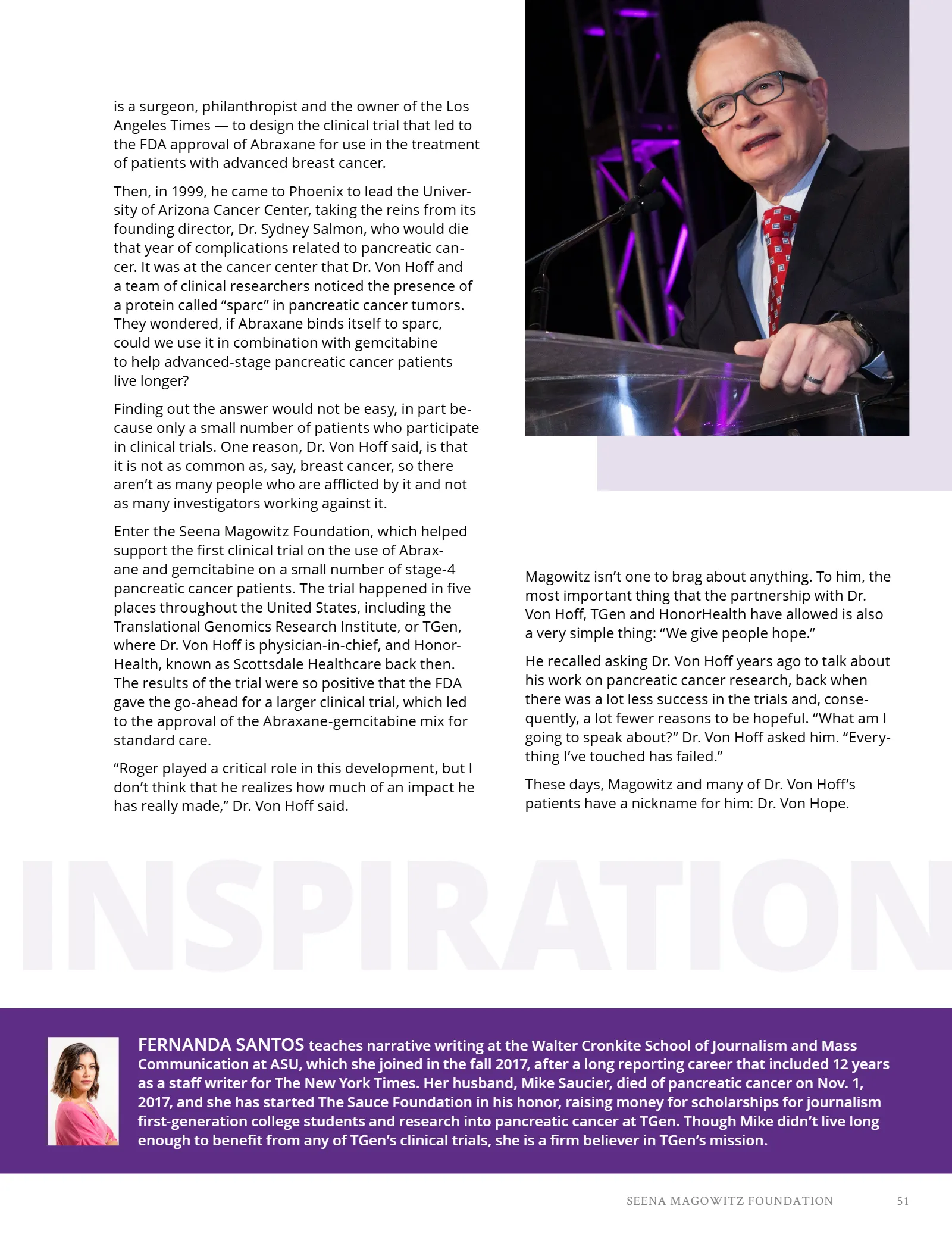
SEENA MAGOWITZ FOUNDATION 51 FERNANDA SANTOS teaches narrative writing at the Walter Cronkite School of Journalism and Mass Communication at ASU, which she joined in the fall 2017, after a long reporting career that included 12 years as a staff writer for The New York Times. Her husband, Mike Saucier, died of pancreatic cancer on Nov. 1, 2017, and she has started The Sauce Foundation in his honor, raising money for scholarships for journalism first-generation college students and research into pancreatic cancer at TGen. Though Mike didn’t live long enough to benefit from any of TGen’s clinical trials, she is a firm believer in TGen’s mission. is a surgeon, philanthropist and the owner of the Los Angeles Times — to design the clinical trial that led to the FDA approval of Abraxane for use in the treatment of patients with advanced breast cancer. Then, in 1999, he came to Phoenix to lead the Univer - sity of Arizona Cancer Center, taking the reins from its founding director, Dr. Sydney Salmon, who would die that year of complications related to pancreatic can - cer. It was at the cancer center that Dr. Von Hoff and a team of clinical researchers noticed the presence of a protein called “sparc” in pancreatic cancer tumors. They wondered, if Abraxane binds itself to sparc, could we use it in combination with gemcitabine to help advanced-stage pancreatic cancer patients live longer? Finding out the answer would not be easy, in part be - cause only a small number of patients who participate in clinical trials. One reason, Dr. Von Hoff said, is that it is not as common as, say, breast cancer, so there aren’t as many people who are afflicted by it and not as many investigators working against it. Enter the Seena Magowitz Foundation, which helped support the first clinical trial on the use of Abrax - ane and gemcitabine on a small number of stage-4 pancreatic cancer patients. The trial happened in five places throughout the United States, including the Translational Genomics Research Institute, or TGen, where Dr. Von Hoff is physician-in-chief, and Honor - Health, known as Scottsdale Healthcare back then. The results of the trial were so positive that the FDA gave the go-ahead for a larger clinical trial, which led to the approval of the Abraxane-gemcitabine mix for standard care. “Roger played a critical role in this development, but I don’t think that he realizes how much of an impact he has really made,” Dr. Von Hoff said. INSPIRATION Magowitz isn’t one to brag about anything. To him, the most important thing that the partnership with Dr. Von Hoff, TGen and HonorHealth have allowed is also a very simple thing: “We give people hope.” He recalled asking Dr. Von Hoff years ago to talk about his work on pancreatic cancer research, back when there was a lot less success in the trials and, conse - quently, a lot fewer reasons to be hopeful. “What am I going to speak about?” Dr. Von Hoff asked him. “Every - thing I’ve touched has failed.” These days, Magowitz and many of Dr. Von Hoff’s patients have a nickname for him: Dr. Von Hope.