
60 SEENA MAGOWITZ FOUNDATION Pancreatic Cancer Warriors ELIZABETH O’CONNOR A UNIQUE STORY To Her, Every Moment Matters JULIA BRABANT | CONTRI BUTI NG WRITER
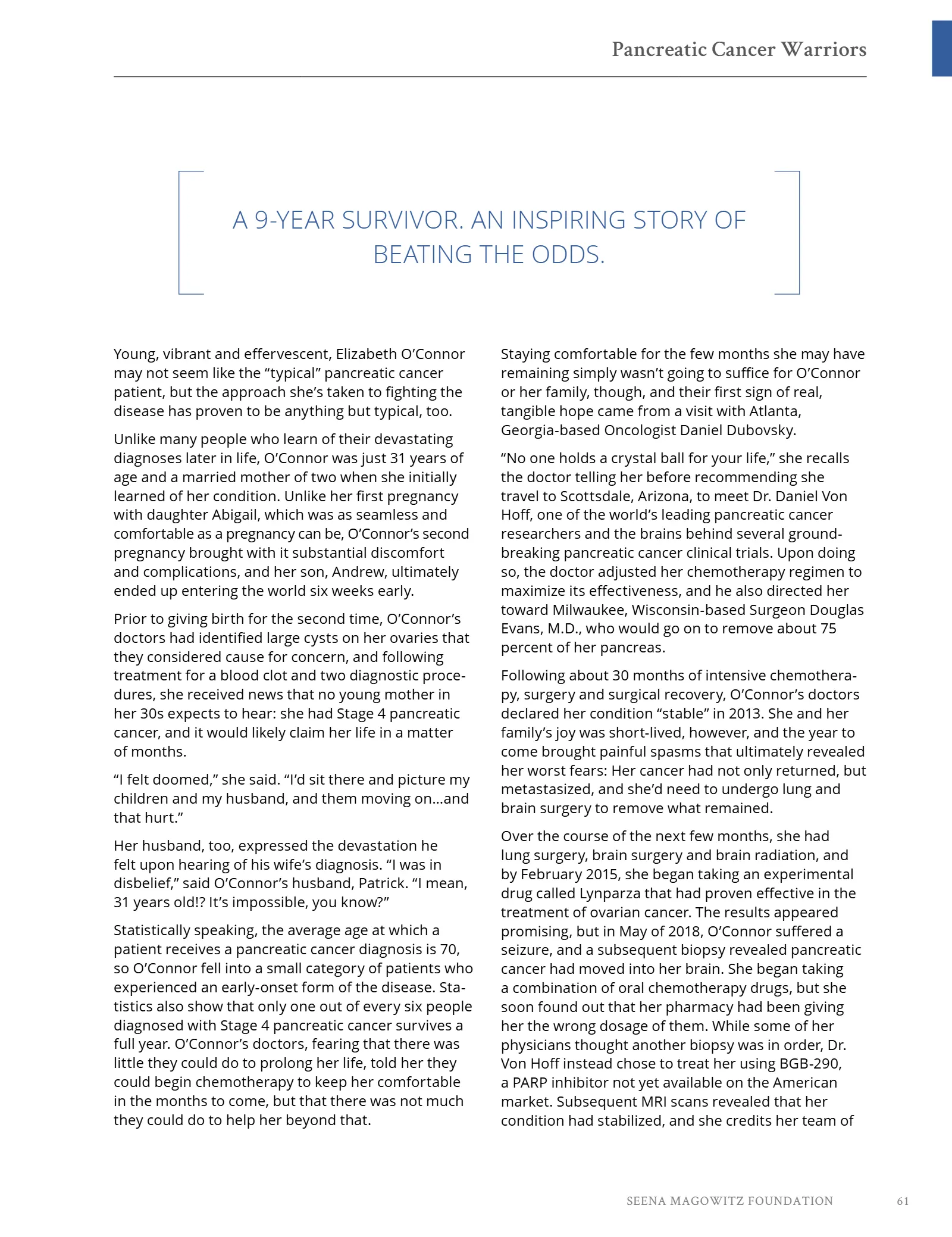
SEENA MAGOWITZ FOUNDATION 61 Pancreatic Cancer Warriors Young, vibrant and effervescent, Elizabeth O’Connor may not seem like the “typical” pancreatic cancer patient, but the approach she’s taken to fighting the disease has proven to be anything but typical, too. Unlike many people who learn of their devastating diagnoses later in life, O’Connor was just 31 years of age and a married mother of two when she initially learned of her condition. Unlike her first pregnancy with daughter Abigail, which was as seamless and comfortable as a pregnancy can be, O’Connor’s second pregnancy brought with it substantial discomfort and complications, and her son, Andrew, ultimately ended up entering the world six weeks early. Prior to giving birth for the second time, O’Connor’s doctors had identified large cysts on her ovaries that they considered cause for concern, and following treatment for a blood clot and two diagnostic proce - dures, she received news that no young mother in her 30s expects to hear: she had Stage 4 pancreatic cancer, and it would likely claim her life in a matter of months. “I felt doomed,” she said. “I’d sit there and picture my children and my husband, and them moving on…and that hurt.” Her husband, too, expressed the devastation he felt upon hearing of his wife’s diagnosis. “I was in disbelief,” said O’Connor’s husband, Patrick. “I mean, 31 years old!? It’s impossible, you know?” Statistically speaking, the average age at which a patient receives a pancreatic cancer diagnosis is 70, so O’Connor fell into a small category of patients who experienced an early-onset form of the disease. Sta - tistics also show that only one out of every six people diagnosed with Stage 4 pancreatic cancer survives a full year. O’Connor’s doctors, fearing that there was little they could do to prolong her life, told her they could begin chemotherapy to keep her comfortable in the months to come, but that there was not much they could do to help her beyond that. Staying comfortable for the few months she may have remaining simply wasn’t going to suffice for O’Connor or her family, though, and their first sign of real, tangible hope came from a visit with Atlanta, Georgia-based Oncologist Daniel Dubovsky. “No one holds a crystal ball for your life,” she recalls the doctor telling her before recommending she travel to Scottsdale, Arizona, to meet Dr. Daniel Von Hoff, one of the world’s leading pancreatic cancer researchers and the brains behind several ground - breaking pancreatic cancer clinical trials. Upon doing so, the doctor adjusted her chemotherapy regimen to maximize its effectiveness, and he also directed her toward Milwaukee, Wisconsin-based Surgeon Douglas Evans, M.D., who would go on to remove about 75 percent of her pancreas. Following about 30 months of intensive chemothera - py, surgery and surgical recovery, O’Connor’s doctors declared her condition “stable” in 2013. She and her family’s joy was short-lived, however, and the year to come brought painful spasms that ultimately revealed her worst fears: Her cancer had not only returned, but metastasized, and she’d need to undergo lung and brain surgery to remove what remained. Over the course of the next few months, she had lung surgery, brain surgery and brain radiation, and by February 2015, she began taking an experimental drug called Lynparza that had proven effective in the treatment of ovarian cancer. The results appeared promising, but in May of 2018, O’Connor suffered a seizure, and a subsequent biopsy revealed pancreatic cancer had moved into her brain. She began taking a combination of oral chemotherapy drugs, but she soon found out that her pharmacy had been giving her the wrong dosage of them. While some of her physicians thought another biopsy was in order, Dr. Von Hoff instead chose to treat her using BGB-290, a PARP inhibitor not yet available on the American market. Subsequent MRI scans revealed that her condition had stabilized, and she credits her team of A 9-YEAR SURVIVOR. AN INSPIRING STORY OF BEATING THE ODDS.