
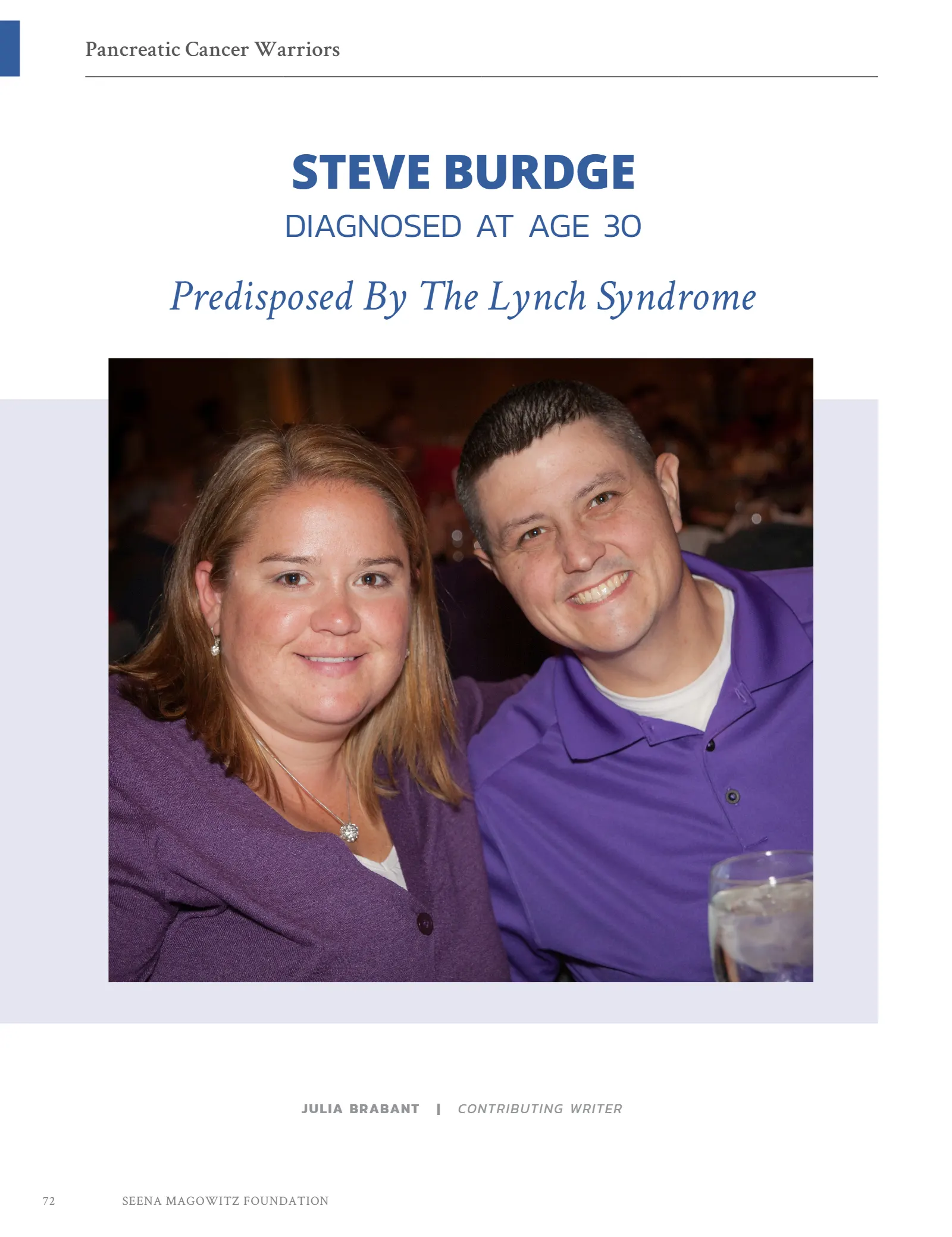
72 SEENA MAGOWITZ FOUNDATION Pancreatic Cancer Warriors STEVE BURDGE DIAGNOSED AT AGE 30 Predisposed By The Lynch Syndrome JULIA BRABANT | CONTRI BUTI NG WRITER
SEENA MAGOWITZ FOUNDATION 73 Pancreatic Cancer Warriors It all began on Labor Day weekend of 2012, when Burdge started experiencing pains severe enough to warrant a visit to the emergency room. Doctors there told him he had a bad bout of the flu before prescribing antibiotics and sending him on his way. By October, though, his symptoms had not only returned, but substantially worsened, and a subsequent visit to the doctor led to a gallstones diagnosis and a recommendation for surgery. Upon waking up from that surgery, Burdge heard news that no 30-year-old father of two expects to hear: He did not, in fact, have gallstones – he had a tumor that turned out to be pancreatic cancer. “I was in the deepest, darkest hole someone could ever be in,” Burdge said, of the weeks and months following his diagnosis, which involved intensive chemotherapy, radiation, and, ultimately, the Whipple surgery, a highly invasive procedure that brought with it considerable complications. Burdge also learned that his own cancer likely resulted from a genetic condition called Lynch syndrome, which would ex - plain why so many family members on his mother’s side also battled various forms of the disease. Upon getting his own children tested, he found out that his daughter, too, had Lynch syndrome, but detecting it early meant that she could receive preventative care to help manage it. Coming to terms with his own pancreatic cancer diagnosis, and then his daughter’s Lynch syndrome diagnosis, was immensely difficult, but some of the strongest support he received along the way was from his own employer, Mattress Firm, which happened to be one of the nation’s most prolific fundraisers for pancreatic cancer research. Through his employer, Steve learned of the tireless work of Dr. Daniel Von Hoff, and when his disease returned, he found himself meeting with the doctor in Arizona. In discussing Steve’s condition and treat - ment, Dr. Von Hoff mentioned touching base with “Dr. Lynch,” and it took a few moments for Burdge to realize that his doctor was referencing the very phy - sician who discovered his rare gene mutation in the first place. It was then that he realized the depth of the world of opportunity opened up by Dr. Von Hoff, and how he could now, thanks to the doctor, connect with world’s best and brightest minds in the fight against cancer. “Dr. Von Hoff was willing to put Steve on a higher dose of chemotherapy than other doctors we’d seen,” said Burdge’s wife, Susan. “His willingness to push the envelope may well be why Steve is still here.” Because of the uncertainty surrounding Burdge’s future, he chose to put together graduation and wedding presents for his children ahead of time in the event he’d be unable to be there for these milestones. Now, though, as his son begins his senior year of high school, it seems Burdge just may be able to give him that graduation gift himself. FOR MANY AMERICANS, THE ONSET OF LABOR DAY WEEKEND MEANS BURGERS, BBQS AND BACK-TO- SCHOOL SHOPPING, BUT FOR STEVE BURDGE, THE LATE-AUGUST CELEBRATION OF SUMMER’S LAST HURRAH SERVES AS AN ANNUAL REMINDER OF ONE OF THE BIGGEST STRUGGLES HE’S EVER FACED.