
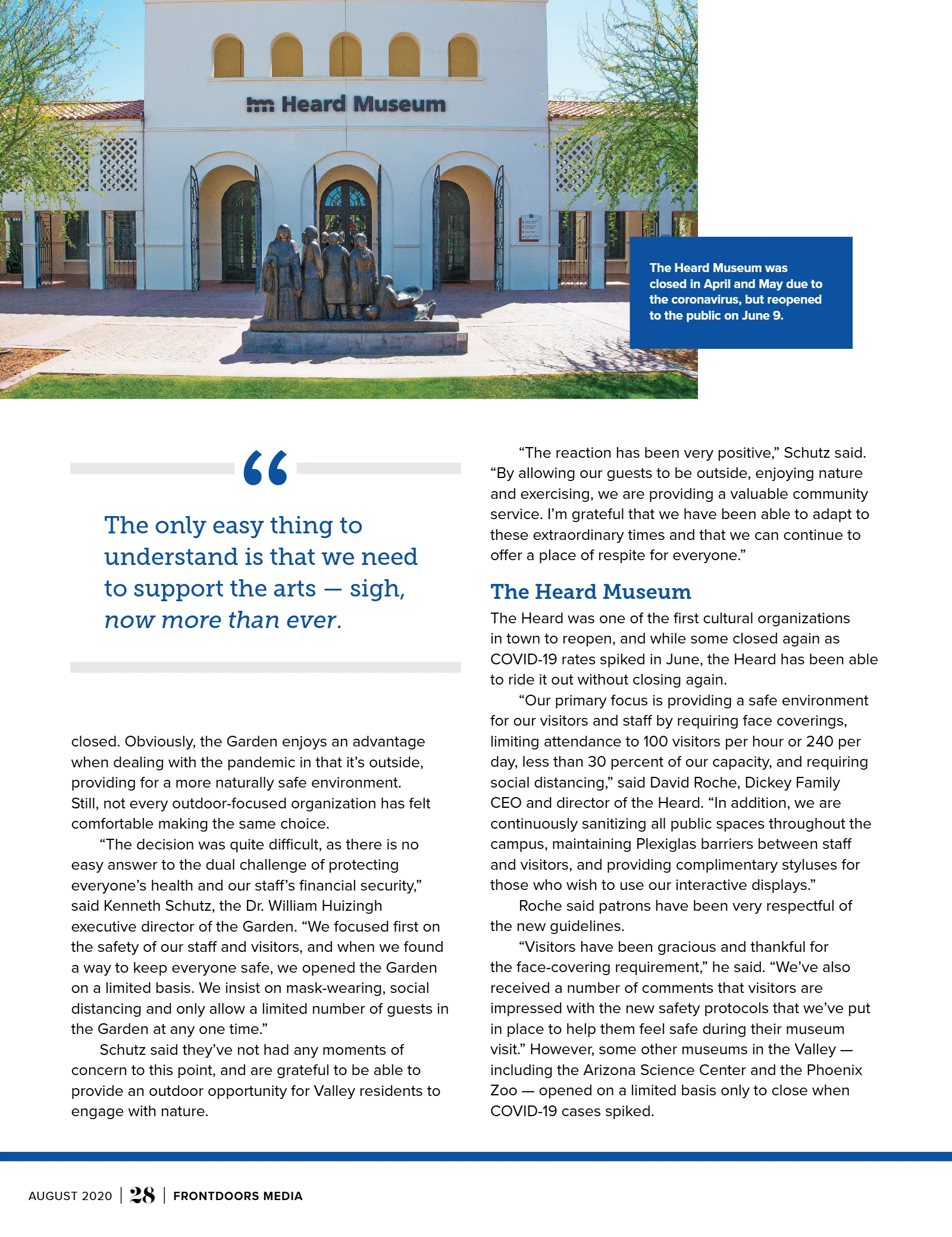
closed. Obviously, the Garden enjoys an advantage when dealing with the pandemic in that it’s outside, providing for a more naturally safe environment. Still, not every outdoor-focused organization has felt comfortable making the same choice. “The decision was quite difficult, as there is no easy answer to the dual challenge of protecting everyone’s health and our staff’s financial security,” said Kenneth Schutz, the Dr. William Huizingh executive director of the Garden. “We focused first on the safety of our staff and visitors, and when we found a way to keep everyone safe, we opened the Garden on a limited basis. We insist on mask-wearing, social distancing and only allow a limited number of guests in the Garden at any one time.” Schutz said they’ve not had any moments of concern to this point, and are grateful to be able to provide an outdoor opportunity for Valley residents to engage with nature. “The reaction has been very positive,” Schutz said. “By allowing our guests to be outside, enjoying nature and exercising, we are providing a valuable community service. I’m grateful that we have been able to adapt to these extraordinary times and that we can continue to offer a place of respite for everyone.” The Heard Museum The Heard was one of the first cultural organizations in town to reopen, and while some closed again as COVID-19 rates spiked in June, the Heard has been able to ride it out without closing again. “Our primary focus is providing a safe environment for our visitors and staff by requiring face coverings, limiting attendance to 100 visitors per hour or 240 per day, less than 30 percent of our capacity, and requiring social distancing,” said David Roche, Dickey Family CEO and director of the Heard. “In addition, we are continuously sanitizing all public spaces throughout the campus, maintaining Plexiglas barriers between staff and visitors, and providing complimentary styluses for those who wish to use our interactive displays.” Roche said patrons have been very respectful of the new guidelines. “Visitors have been gracious and thankful for the face-covering requirement,” he said. “We’ve also received a number of comments that visitors are impressed with the new safety protocols that we’ve put in place to help them feel safe during their museum visit.” However, some other museums in the Valley — including the Arizona Science Center and the Phoenix Zoo — opened on a limited basis only to close when COVID-19 cases spiked. The Heard Museum was closed in April and May due to the coronavirus, but reopened to the public on June 9. “ The only easy thing to understand is that we need to support the arts — sigh, now more than ever . AUGUST 2020 | 28 | FRONTDOORS MEDIA
Arizona Opera Nothing in the arts and culture space has been hit harder than the performing arts, for obvious reasons. And with no end to the pandemic in immediate sight, performing arts organizations are having to make some extraordinarily difficult decisions. From a public performance standpoint, 2020 is pretty much a loss. It’s making it to 2021 that becomes the challenge. The Arizona Opera is doing its best to make the upcoming 2020-21 season engaging for patrons, focusing on a series of outdoor performances announced in late July. The details of these performances are being fleshed out, but will also include a virtual component. “Our patrons have clearly expressed that they remain committed to staying connected with Arizona Opera and our art form, but that they are not ready to return to an in-theater setting under current circumstances,” said Arizona Opera’s president and general director, Joseph Specter. “We are determined, nevertheless, to continue serving communities throughout our state and beyond through a variety of outdoor and digital offerings that take advantage of the beauty of Arizona during the opera season.” But other arts organizations might not be able to make virtual or outdoor performances work — and frankly, no one knows what in-person performances will look like in the coming months, and when they will be able to take place. So, many organizations across the country are punting on 2020-2021, and instead focusing on the hopes of a robust comeback in fall 2021. No Easy Answers Look, every decision is hard right now. And if you own a business or run a nonprofit, you know that your organization’s very survival is dependent on the hardest question we’ve ever been presented with as a society — how do we continue to function, and at the same time keep people safe? There are no easy answers, of course. The only easy thing to understand is that we need to support the arts — sigh, now more than ever . Whether they’re able to open their doors or not, it’s critical that we help them make it to the other side of this public health crisis. So do what you think is right, and do what you feel is best for you and the arts organizations you love. If that means going out, then go out. If not, and you have the means to help, then get your checkbook out. If you do, when all of this is over, we’ll enjoy and savor the arts more than we ever have before. Tom Evans | CONTRIBUTING EDITOR Over the past few months, a large number of philanthropic events have been postponed or canceled. The good news is that many of us have still found a way to do our part. I want to give huge, well-deserved kudos to all of the men and women of the Leukemia Lymphoma Society’s Man/Woman of the Year campaign. These candidates accomplished a huge achievement in their fundraising, all while practicing safeguards regarding the pandemic. Things may be different for us all, but the culture of fundraising remains. There are still many ways to volunteer and give back. For instance, Arizona Helping Hands is the largest provider of necessities for children in foster care in the state. Volunteer opportunities are available Monday through Friday with morning or afternoon options, each lasting approximately two hours. For more info, go to azhelphands.org. KIESHA McFADDEN CHECKING IN WITH... THE CULTURE OF PHILANTHROPY /// MARKET UPDATE /// The U.S. homeownership rate soared to an almost 12-year high in the second quarter as low interest rates allowed more Americans to qualify for mortgages. The homeownership rate jumped to 67.9% from 65.3% in the first quarter. According to the Census Bureau, homeownership is the highest it has been since the third quarter of 2008. Homeownership for Black Americans rose 3% during the second quarter to 47%, the highest since 2008. The rate for Hispanics increased to 51.4%, the highest going back to 1994. The cheapest financing costs on record have widened the pool of people who qualify for mortgages, said Lawrence Yun, chief economist for the National Association of Realtors. Lenders qualify applicants by the amount of the monthly payment measured against their income, and when financing costs go down, the payment shrinks. “Lower rates always do a magic trick of bringing more buyers into the housing market,” Yun said. With mortgage rates at record lows, now is an excellent time to refinance and save money on your monthly payment or even shorten your term and keep the same payment. 16930 E. Palisades Blvd., Fountain Hills, AZ 85268 NMLS #1467650 KIESHA MCFADDEN | 480.252.9365 Kiesha@TolisMortgageUSA.com NMLS #198458