
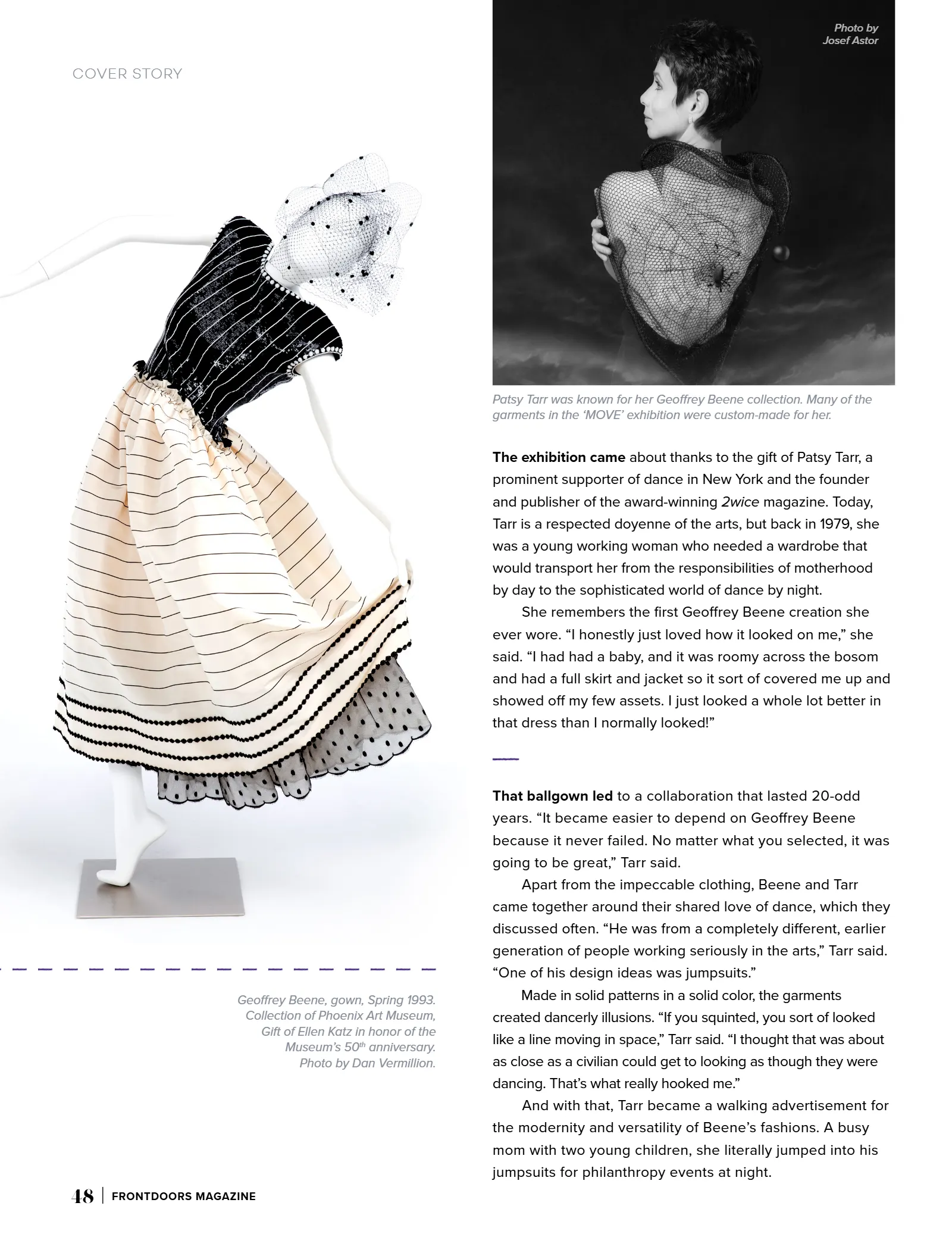
COVER STORY 48 | FRONTDOORS MAGAZINE The exhibition came about thanks to the gift of Patsy Tarr, a prominent supporter of dance in New York and the founder and publisher of the award-winning 2wice magazine. Today, Tarr is a respected doyenne of the arts, but back in 1979, she was a young working woman who needed a wardrobe that would transport her from the responsibilities of motherhood by day to the sophisticated world of dance by night. She remembers the first Geoffrey Beene creation she ever wore. “I honestly just loved how it looked on me,” she said. “I had had a baby, and it was roomy across the bosom and had a full skirt and jacket so it sort of covered me up and showed off my few assets. I just looked a whole lot better in that dress than I normally looked!” That ballgown led to a collaboration that lasted 20-odd years. “It became easier to depend on Geoffrey Beene because it never failed. No matter what you selected, it was going to be great,” Tarr said. Apart from the impeccable clothing, Beene and Tarr came together around their shared love of dance, which they discussed often. “He was from a completely different, earlier generation of people working seriously in the arts,” Tarr said. “One of his design ideas was jumpsuits.” Made in solid patterns in a solid color, the garments created dancerly illusions. “If you squinted, you sort of looked like a line moving in space,” Tarr said. “I thought that was about as close as a civilian could get to looking as though they were dancing. That’s what really hooked me.” And with that, Tarr became a walking advertisement for the modernity and versatility of Beene’s fashions. A busy mom with two young children, she literally jumped into his jumpsuits for philanthropy events at night. Geoffrey Beene, gown, Spring 1993. Collection of Phoenix Art Museum, Gift of Ellen Katz in honor of the Museum’s 50 th anniversary. Photo by Dan Vermillion. Patsy Tarr was known for her Geoffrey Beene collection. Many of the garments in the ‘MOVE’ exhibition were custom-made for her. Photo by Josef Astor
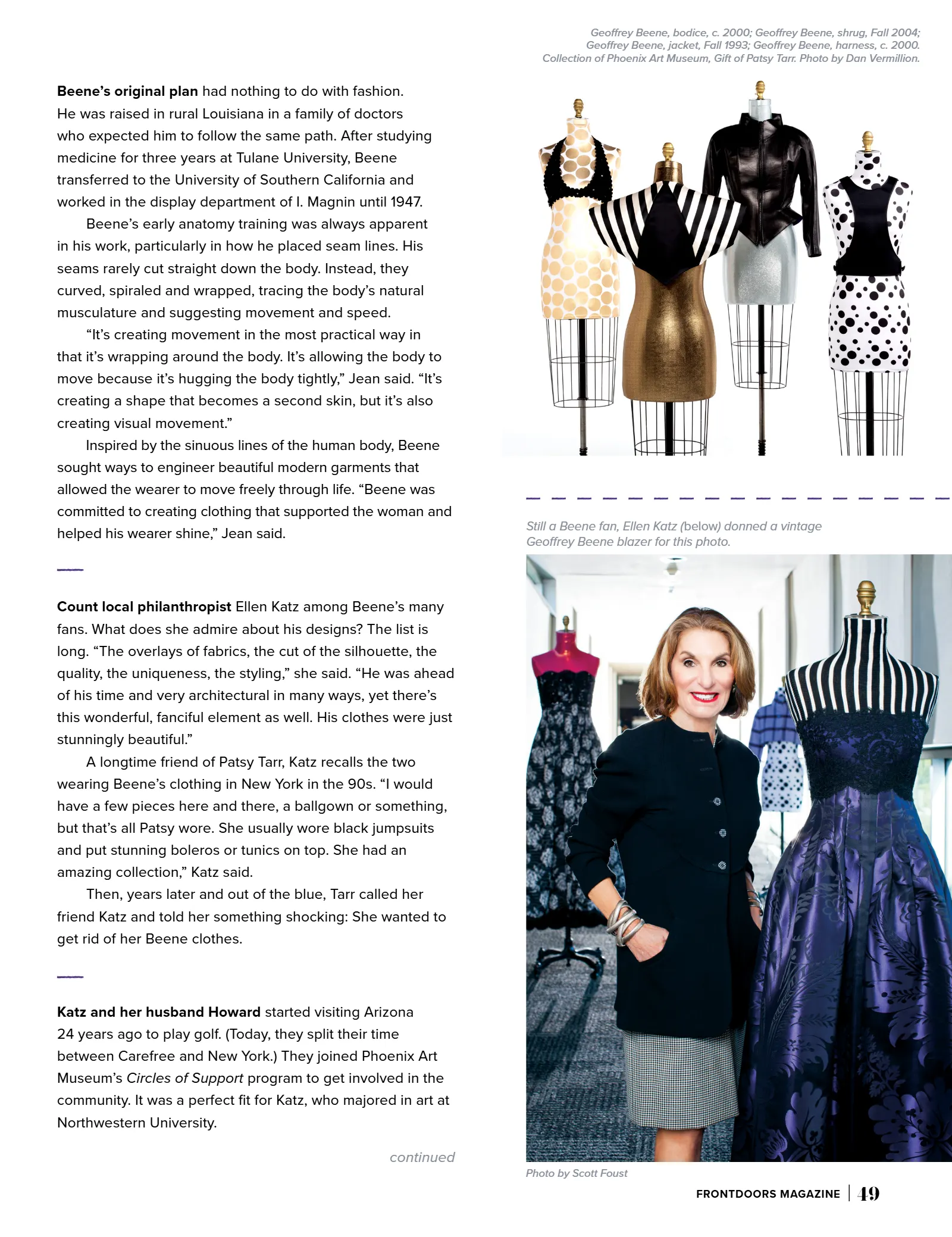
FRONTDOORS MAGAZINE | 49 Beene’s original plan had nothing to do with fashion. He was raised in rural Louisiana in a family of doctors who expected him to follow the same path. After studying medicine for three years at Tulane University, Beene transferred to the University of Southern California and worked in the display department of I. Magnin until 1947. Beene’s early anatomy training was always apparent in his work, particularly in how he placed seam lines. His seams rarely cut straight down the body. Instead, they curved, spiraled and wrapped, tracing the body’s natural musculature and suggesting movement and speed. “It’s creating movement in the most practical way in that it’s wrapping around the body. It’s allowing the body to move because it’s hugging the body tightly,” Jean said. “It’s creating a shape that becomes a second skin, but it’s also creating visual movement.” Inspired by the sinuous lines of the human body, Beene sought ways to engineer beautiful modern garments that allowed the wearer to move freely through life. “Beene was committed to creating clothing that supported the woman and helped his wearer shine,” Jean said. Count local philanthropist Ellen Katz among Beene’s many fans. What does she admire about his designs? The list is long. “The overlays of fabrics, the cut of the silhouette, the quality, the uniqueness, the styling,” she said. “He was ahead of his time and very architectural in many ways, yet there’s this wonderful, fanciful element as well. His clothes were just stunningly beautiful.” A longtime friend of Patsy Tarr, Katz recalls the two wearing Beene’s clothing in New York in the 90s. “I would have a few pieces here and there, a ballgown or something, but that’s all Patsy wore. She usually wore black jumpsuits and put stunning boleros or tunics on top. She had an amazing collection,” Katz said. Then, years later and out of the blue, Tarr called her friend Katz and told her something shocking: She wanted to get rid of her Beene clothes. Katz and her husband Howard started visiting Arizona 24 years ago to play golf. (Today, they split their time between Carefree and New York.) They joined Phoenix Art Museum’s Circles of Support program to get involved in the community. It was a perfect fit for Katz, who majored in art at Northwestern University. continued Geoffrey Beene, bodice, c. 2000; Geoffrey Beene, shrug, Fall 2004; Geoffrey Beene, jacket, Fall 1993; Geoffrey Beene, harness, c. 2000. Collection of Phoenix Art Museum, Gift of Patsy Tarr. Photo by Dan Vermillion. Still a Beene fan, Ellen Katz ( below ) donned a vintage Geoffrey Beene blazer for this photo. Photo by Scott Foust