
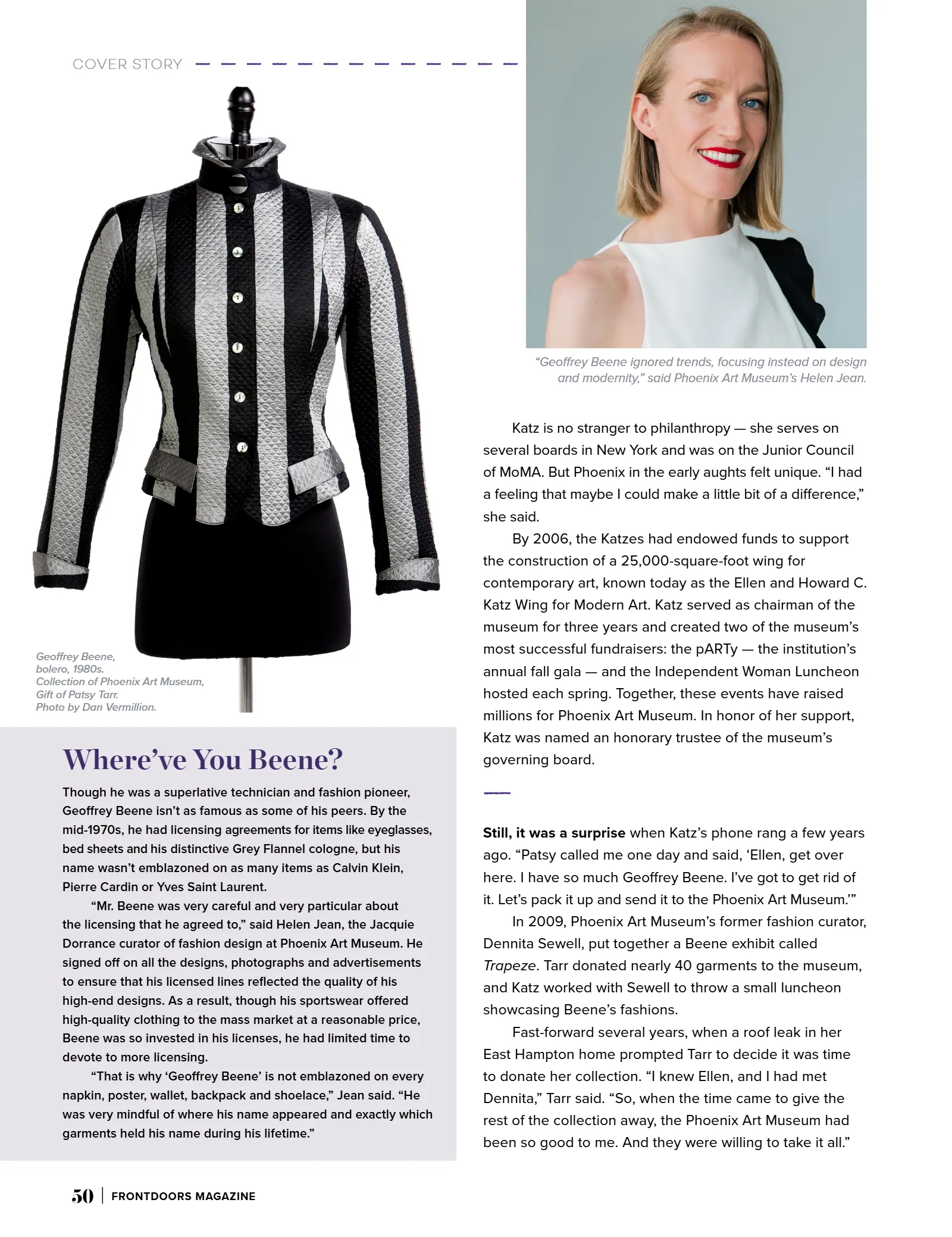
Where’ve You Beene? Though he was a superlative technician and fashion pioneer, Geoffrey Beene isn’t as famous as some of his peers. By the mid-1970s, he had licensing agreements for items like eyeglasses, bed sheets and his distinctive Grey Flannel cologne, but his name wasn’t emblazoned on as many items as Calvin Klein, Pierre Cardin or Yves Saint Laurent. “Mr. Beene was very careful and very particular about the licensing that he agreed to,” said Helen Jean, the Jacquie Dorrance curator of fashion design at Phoenix Art Museum. He signed off on all the designs, photographs and advertisements to ensure that his licensed lines reflected the quality of his high-end designs. As a result, though his sportswear offered high-quality clothing to the mass market at a reasonable price, Beene was so invested in his licenses, he had limited time to devote to more licensing. “That is why ‘Geoffrey Beene’ is not emblazoned on every napkin, poster, wallet, backpack and shoelace,” Jean said. “He was very mindful of where his name appeared and exactly which garments held his name during his lifetime.” COVER STORY “Geoffrey Beene ignored trends, focusing instead on design and modernity,” said Phoenix Art Museum’s Helen Jean. Katz is no stranger to philanthropy — she serves on several boards in New York and was on the Junior Council of MoMA. But Phoenix in the early aughts felt unique. “I had a feeling that maybe I could make a little bit of a difference,” she said. By 2006, the Katzes had endowed funds to support the construction of a 25,000-square-foot wing for contemporary art, known today as the Ellen and Howard C. Katz Wing for Modern Art. Katz served as chairman of the museum for three years and created two of the museum’s most successful fundraisers: the pARTy — the institution’s annual fall gala — and the Independent Woman Luncheon hosted each spring. Together, these events have raised millions for Phoenix Art Museum. In honor of her support, Katz was named an honorary trustee of the museum’s governing board. Still, it was a surprise when Katz’s phone rang a few years ago. “Patsy called me one day and said, ‘Ellen, get over here. I have so much Geoffrey Beene. I’ve got to get rid of it. Let’s pack it up and send it to the Phoenix Art Museum.’” In 2009, Phoenix Art Museum’s former fashion curator, Dennita Sewell, put together a Beene exhibit called Trapeze . Tarr donated nearly 40 garments to the museum, and Katz worked with Sewell to throw a small luncheon showcasing Beene’s fashions. Fast-forward several years, when a roof leak in her East Hampton home prompted Tarr to decide it was time to donate her collection. “I knew Ellen, and I had met Dennita,” Tarr said. “So, when the time came to give the rest of the collection away, the Phoenix Art Museum had been so good to me. And they were willing to take it all.” 50 | FRONTDOORS MAGAZINE Geoffrey Beene, bolero, 1980s. Collection of Phoenix Art Museum, Gift of Patsy Tarr. Photo by Dan Vermillion.
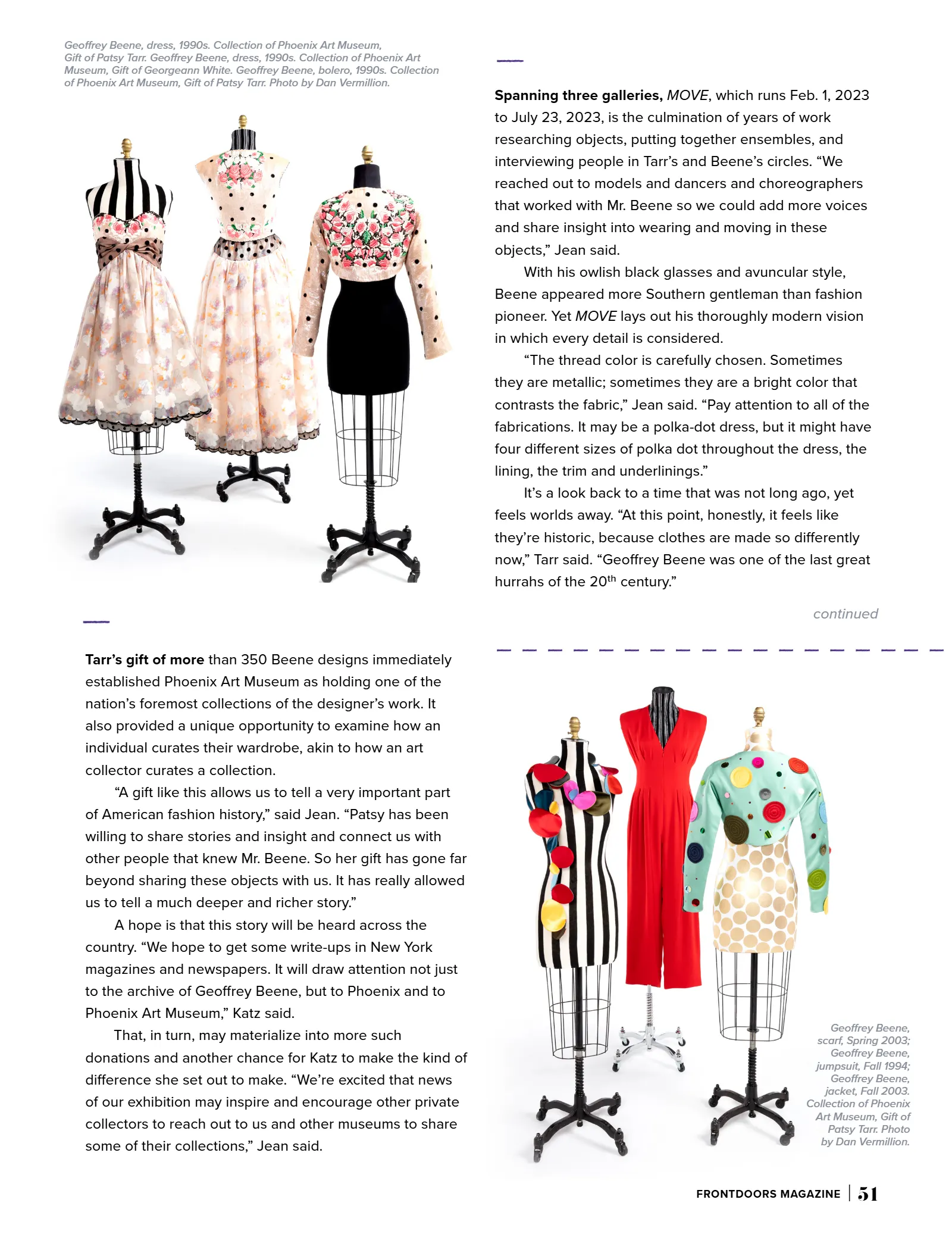
Tarr’s gift of more than 350 Beene designs immediately established Phoenix Art Museum as holding one of the nation’s foremost collections of the designer’s work. It also provided a unique opportunity to examine how an individual curates their wardrobe, akin to how an art collector curates a collection. “A gift like this allows us to tell a very important part of American fashion history,” said Jean. “Patsy has been willing to share stories and insight and connect us with other people that knew Mr. Beene. So her gift has gone far beyond sharing these objects with us. It has really allowed us to tell a much deeper and richer story.” A hope is that this story will be heard across the country. “We hope to get some write-ups in New York magazines and newspapers. It will draw attention not just to the archive of Geoffrey Beene, but to Phoenix and to Phoenix Art Museum,” Katz said. That, in turn, may materialize into more such donations and another chance for Katz to make the kind of difference she set out to make. “We’re excited that news of our exhibition may inspire and encourage other private collectors to reach out to us and other museums to share some of their collections,” Jean said. FRONTDOORS MAGAZINE | 51 Spanning three galleries, MOVE , which runs Feb. 1, 2023 to July 23, 2023, is the culmination of years of work researching objects, putting together ensembles, and interviewing people in Tarr’s and Beene’s circles. “We reached out to models and dancers and choreographers that worked with Mr. Beene so we could add more voices and share insight into wearing and moving in these objects,” Jean said. With his owlish black glasses and avuncular style, Beene appeared more Southern gentleman than fashion pioneer. Yet MOVE lays out his thoroughly modern vision in which every detail is considered. “The thread color is carefully chosen. Sometimes they are metallic; sometimes they are a bright color that contrasts the fabric,” Jean said. “Pay attention to all of the fabrications. It may be a polka-dot dress, but it might have four different sizes of polka dot throughout the dress, the lining, the trim and underlinings.” It’s a look back to a time that was not long ago, yet feels worlds away. “At this point, honestly, it feels like they’re historic, because clothes are made so differently now,” Tarr said. “Geoffrey Beene was one of the last great hurrahs of the 20th century.” continued Geoffrey Beene, dress, 1990s. Collection of Phoenix Art Museum, Gift of Patsy Tarr. Geoffrey Beene, dress, 1990s. Collection of Phoenix Art Museum, Gift of Georgeann White. Geoffrey Beene, bolero, 1990s. Collection of Phoenix Art Museum, Gift of Patsy Tarr. Photo by Dan Vermillion. Geoffrey Beene, scarf, Spring 2003; Geoffrey Beene, jumpsuit, Fall 1994; Geoffrey Beene, jacket, Fall 2003. Collection of Phoenix Art Museum, Gift of Patsy Tarr. Photo by Dan Vermillion.