
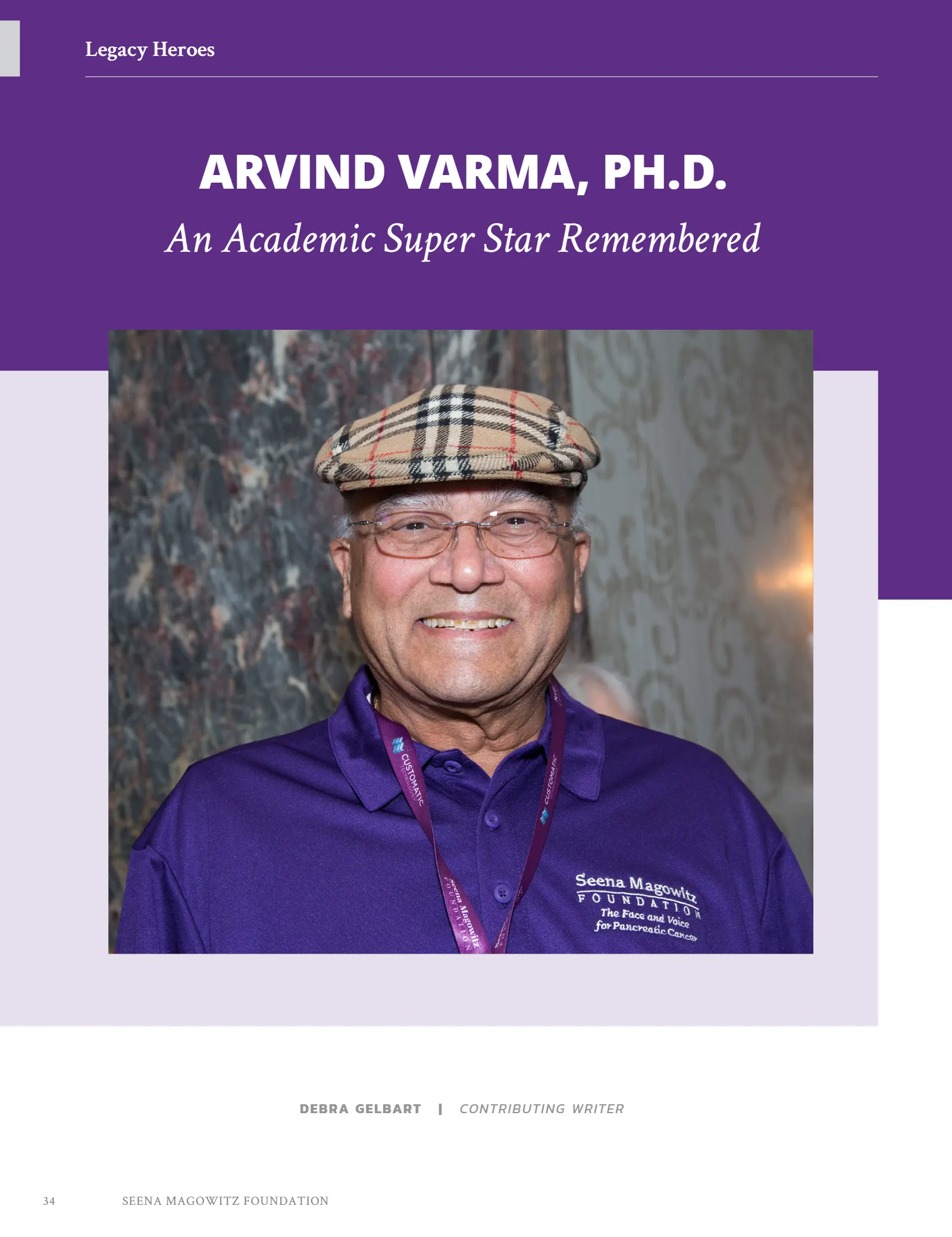
34 SEENA MAGOWITZ FOUNDATION DE BRA G E LBART | CONTRI BUTI NG WRITER ARVIND VARMA, PH.D. An Academic Super Star Remembered Legacy Heroes
SEENA MAGOWITZ FOUNDATION 35 Legacy Heroes RESEARCH PROVES TO BE A LIFESAVER The only symptoms Arvind Varma, Ph.D. had before his diagnosis were a persistent, but not severe, stomachache and some weight loss. The weight loss didn’t alarm him because he had been trying to shed a few pounds. That was in October 2015. But the pain concerned him enough to visit his doctor, and in November of that year, he learned he had Stage 4 pancreatic cancer. As devastating as the diagnosis was, it wasn’t entirely unexpected. “I have a long family history of cancer,” Dr. Varma told assembled guests in August 2017 at the Seena Magowitz Foundation Annual Golf Classic in Boston. “My mother died at age 37 of esophageal cancer when I was 8 years old. My younger sister and eldest brother also died of cancer. Another older brother had breast cancer which was caught early and cured. So I regularly had tests to see if cancer was coming for me.” No one diagnosed with pancreatic cancer with me - tastasis to the liver would ever consider themselves lucky, but sometimes timing can save your life. Dr. Varma, a professor of chemical engineering at Purdue University in Indiana, immediately began researching the best place to seek treatment. He chose the Translational Genomics Research Institute (TGen) and HonorHealth Research Institute in Scottsdale, Arizona. He was able to become patient #19 in a clinical trial called the TGen Triple for 25 Stage 4 pancreatic cancer patients who had no previous treatment. He and his wife Karen relocated to Scottsdale for seven months so he could receive the treatment, a combination of three chemotherapy drugs that had not been combined before to treat pancreatic cancer. Dr. Varma was also the head of the School of Chemical Engineering at Purdue at that time. Throughout his treatment, he was able to continue his work remotely, regularly conferring with colleagues and students through email and Skype. AN AMAZING RESPONSE His clinical response to the treatment was nothing short of stunning. Before he enrolled in the study, his tumor marker — one way doctors and researchers assess the extent of a particular cancer — was 5,500. A normal value is 0 to 37. Immediately after he fin - ished the treatment, his tumor marker had dropped to 120. He returned to Indiana in July 2016. Since then, he has taken an oral chemotherapy, Lynparaza, twice daily. Currently, his tumor marker is 11 — comfortably in the normal range. And his scans show no evidence of disease. While he was undergoing treatment in Scottsdale, Dr. Varma also had genetic testing, which revealed that he has a BRCA 2 mutation, making him more susceptible to pancreatic cancer. He believes this also explained his family history of related cancers. Of the 24 patients the research team was able to evaluate in the TGen Triple study, two had what’s called a “complete response,” meaning they had no evidence of disease when they had their best re - sponse to treatment. Another 15 patients, like Dr. Varma, had a “partial response” — a reduction by at least 30 percent in the size of their tumors and a falling tumor marker. Four patients experienced no change in their disease and three experienced an advancement of the cancer. PARTICULARS OF THE REGIMEN The three drugs administered in combination were Abraxane, Gemcitabine and Cisplatin. Abaxane plus Gemcitabine already is FDA-approved for treatment of advanced pancreatic cancer. Research has shown that tumor cells like those in pancreatic cancer possess DNA repair problems, so they may be highly sensitive to the drug Cisplatin. DR. ARVIND VARMA RECENTLY PASSED AWAY IN JULY 2019. THE FOLLOWING WAS HIS STORY.